 Newsletter
signup
Newsletter
signup
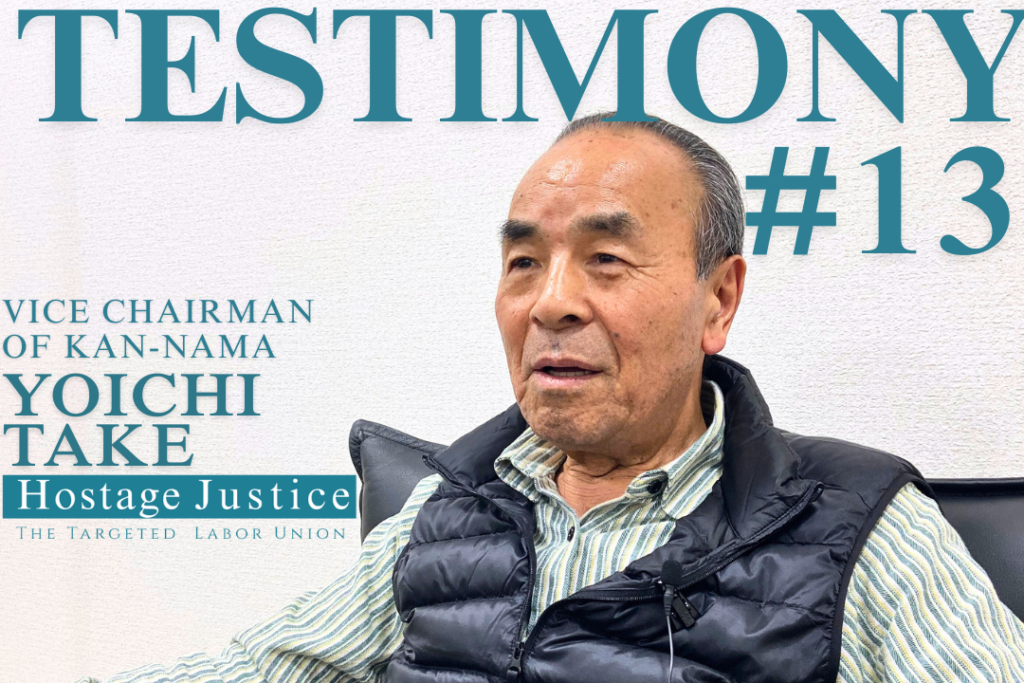
45 Years of Fighting Even When Chased by Excavators: Why “The Yakuza Are Spared and Kan-Nama Is Arrested” / Kan-Nama Vice Chairman Yoichi Take【Kansai Ready-Mixed Concrete Case Testimony #13】
2026.01.28 14:33 Makoto Watanabe, Nanami Nakagawa
In the 1980s, Chairman of the Japan Federation of Employers’ Association (now the Japan Business Federation), Bunpei Otsuki, restrained the activities of Kan-nama.
“A threat to the very foundation of capitalism.”
“I will not let Kan-nama’s movement (in the west region) spread to the rest of Japan.”
Otsuki became chairman of the Japan Federation of Employers’ Association in 1979. The same year, Kan-nama’s current Vice-Chairman Yoichi Take began his activism at Kan-nama. Take testified:
“The crackdown came every 10 years, when the labor movement in Kan-nama gained momentum.”
When Kan-nama comes in the way of authority, the oppressive trio appears: “ready-mixed concrete managers,” “people connected to organized crime,” and “police.”
Take has continued to fight despite overwhelming odds. What has motivated him for the past 45 years?
The business world fears Kan-nama’s expansion into Tokyo
In the 1980s, Kan-nama’s movement was in full swing. I was a mixer truck driver, and even as a daily wage worker, I was making 16,000 yen a day. I had previously worked as a truck driver, but when I started working as a ready-mixed concrete mixer truck driver, I was so surprised that I wondered if I had gotten the amount wrong.
This is thanks to the labor movement of Kan-nama, but when the movement gains momentum, the business community becomes troubled.
Bunpei Otsuki, the chairman of the Japan Federation of Employers’ Association and also the chairman of Mitsubishi Mining and Cement, once said in the newspapers, “I will not let Kan-nama’s movement (in the west region) spread to the rest of Japan.” From the perspective of those who control capitalism, they want to confine labor unions to company unions. If industrial unions like Kan-nama were to spread beyond the western region and into Tokyo, the industrial structure itself would be turned upside down.
Managers in the ready-mix concrete industry have long said that the activities of Kan-nama amount to “obstruction of business by force,” but it’s them who are causing all this nonsense. When we go to protest, we get chased around with excavators. You know those water hoses that fire departments use? One time a union member was hit with the metal fittings of one of those hoses, splitting his head open.
The managers are also connected to the yakuza, and they threaten us by mentioning the yakuza.
Even so, it’s Kan-nama that gets arrested by the police. Those in power feel a sense of crisis that if Kan-nama’s movement spreads, the social structure will change. I think there’s a force at work that says it’s better to attack Kan-nama than to attack the yakuza.
Lessons from the Great Hanshin-Awaji Earthquake
If labor unions don’t strictly adhere to compliance, the world will go crazy.
During the Great Hanshin-Awaji Earthquake in 1995, no one ever dreamed that so many concrete structures would collapse. We went to investigate the locations of collapsed highways and buildings. We found that the reinforced concrete pillars had become empty spaces. They were filled with garbage like 18L cans, rubber boots, rubble, and safety boots. No wonder they collapsed. They were cutting corners.
Workers must be accountable for their work and take pride in it, regardless of the industry—construction, automotive, or any other. In order to make sure that policies and procedures are being properly followed on the job site, labor unions monitor compliance activities. The idea that this amounts to forceful obstruction of business is ludicrous.
I would like to say something especially to the current members of the Japanese Trade Union Confederation (JTUC). For example, what did JTUC do when Toyota was involved in a scandal? It is no good if the members of JTUC affiliates do not have a sense of responsibility and pride in their work.
On the contrary, Kan-nama has this awareness. Because it goes beyond the boundaries of the union, political power and large corporations probably won’t allow it.
Oppression Comes Every 10 Years
When the Shiga Prefectural Police Organized Crime Department came to Kana-nama’s office during this crackdown that began in 2018, they said, “We’ve received orders from above, so we’ll be thorough this time.” One investigator had stickers of the Rising Sun flag on the back of his smartphone. Why did the Shiga Prefectural Police deploy the Organized Crime Department, which is in charge of looking into organized crime, even though the Osaka Prefectural Police were from the Security Department?
This time, I was arrested by the Osaka Prefectural Police on suspicion of obstruction of business by force, even though I hadn’t even been to the strike site. Newspaper reporters were gathered at my house. I asked them why they knew about the arrest first. I told the police that it was annoying and to let them go. After letting them go, I had a police car parked in front of my house and quickly got in. That way, I wouldn’t be photographed being arrested.
In the end, no charges were filed. I remained silent during the interrogation. When I asked the prosecutor to let me go home, he was reading a book. I told him I didn’t want to join him in reading, but he wouldn’t let me go home.
Oppression of Kan-nama comes every 10 years. But this time, the scale and viciousness are completely different. While large corporations have weakened over the past 30 years, the number of non-regular workers has increased. Perhaps this is the time when “if we start speaking out, it will become unbearable.”
[Reporter’s Postscript] The crucial contradiction of the Japanese police / Editor-in-Chief Makoto Watanabe
The members of Kan-nama have been through so much that they are no longer surprised by small things. Yoichi Take, who has been active in Kan-nama for 45 years, is a prime example.
He casually said stuff like “the management of the ready-mix concrete company split a union members’s head open by a metal fitting of a fire hose” and “I was chased around with an excavator.”
However, for those reporting on the story, it is a constant surprise.
The way the police treated people with ties to organized crime shocked me the most. Kan-nama was being suppressed by the managers of the ready-mix concrete industry by people with ties to gangs. In spite of this, Kan-nama has been targeted by the police, who have portrayed the management as the victim.
This may be a familiar sight for the members at Kan-nama. Even in the crackdown that began in 2018, gang affiliations and former gang members have been sent to Kan-nama by management.
However, for the Japanese police, organized crime should be a target of destruction.
In three “Operation Summit” campaigns beginning in 1964, the police targeted the leaders and aimed to weaken the gangs. After the Act on Prevention of Unjust Acts by Organized Crime Group Members was enacted in 1991, crackdowns became more severe. Forced investigations were repeatedly carried out on suspicion of minor offenses, and it seemed that anything was possible to destroy the gangs. Information about raids on gang offices was leaked to the media, and the police were allowed to film these scenes to highlight the “success” of the police.
Why do they aim to eliminate gangs while tacitly tolerating the connections between ready-mix concrete managers and those connected to gangs? Take’s opinion is sharp.
“Those in power feel a sense of crisis that if Kan-nama’s movement spreads, the social structure will change. I think there is a force at work that says it would be better to attack Kan-nama than to attack the yakuza.”
The number of non-regular workers is increasing, widening the gap between them and regular employees at large companies. Even if politicians don’t want to change the current social structure, it must change.
If social unrest increases, public order will also deteriorate. The police should be keenly aware of this.
(Originally published in Japanese on May 14, 2025. Translation by Mana Shibata.)