
 Newsletter
signup
Newsletter
signup
Judges Are “Bureaucrats in Judges’ Robes,” the Media “Ambushed With the Police,” the Days When He Kept the Members Together / Kan-Nama Advisor, Fuyuki Sakata 【Kansai Ready-Mixed Concrete Incident Testimony #12】
2025.12.26 9:22 Makoto Watanabe, Nanami Nakagawa
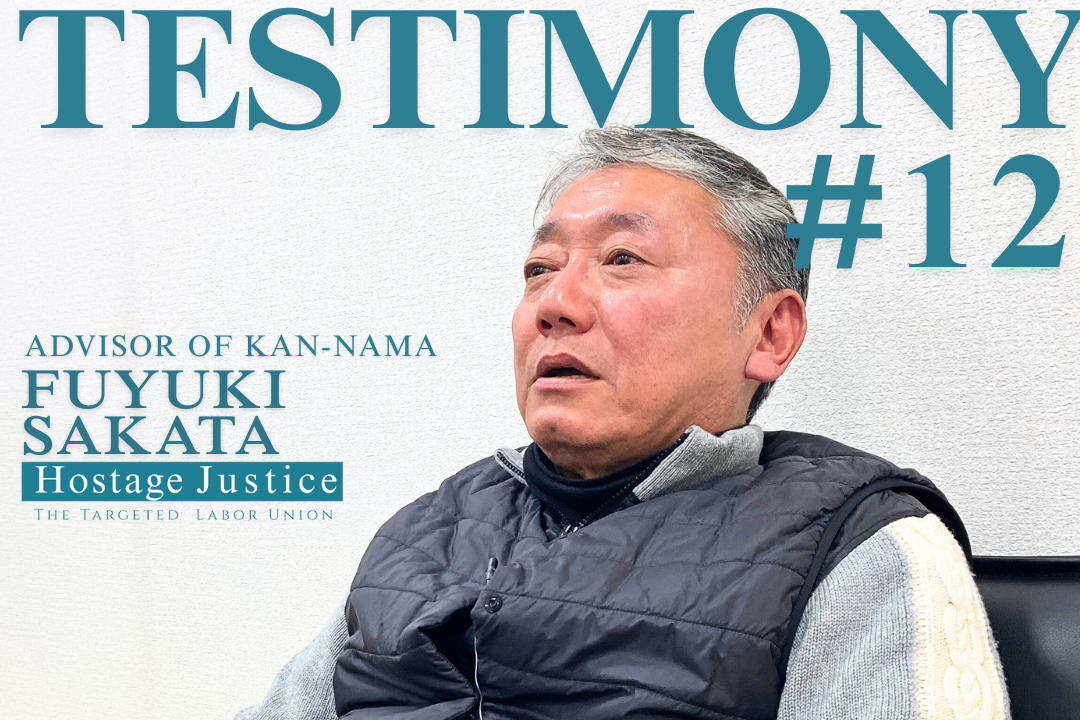
The 12th testimony in this series is from Fuyuki Sakata, an advisor at the Kan-nama. While the mainstays of the union, including current chairman Yuji Yukawa, were away due to police arrests, he worked hard, both physically and mentally, to prevent members from quitting the union.
However, the judge allowed the unjust detention as requested by the prosecutors. Sakata says that the judges are “bureaucrats in judges’ robes” who were not familiar with the law and were easily persuaded by those in power.
The mainstream media’s “media scrum” also intensified the criticism against Kan-nama.
Members of the union left one by one. Nevertheless, what he wants to tell now is that “the Kan-nama is operating with dignity.”
Establishing a Kan-nama chapter at Konoike Group
In 1988, I became a member of Kan-nama. I started a chapter of Kan-nama while I was employed in the general contractor Konoike Group’s transportation division. In addition to improper management of time cards, employees were not receiving compensation for working on holidays. I sought to persuade the corporation to make improvements because the Labor Standards Act was not being properly followed.
My company didn’t like it. It was the kind of company that kept an eye on the workplace to ensure no employees joined industrial unions like Kan-nama. They asked me if it was okay for me to be a member of the Kan-nama, subtly urging me to quit. I couldn’t confirm whether the person was sent by the company, but a man who looked like he was a gangstar began following me from the time I came to work until the time I left.
I left the Konoike Group because I felt stifled by the company’s surveillance. I wanted to work with joy every day. I started working as a mixer truck driver at another company while joining Kan-nama.
Interviewed by Yomiuri TV just before the arrest
In 2011, I was arrested by the Osaka Prefectural Police Security Division. I was charged with intimidation and obstruction of business when I protested against a ready-mix concrete company that refused to engage in collective bargaining. This was a legitimate labor union activity, as I was demanding collective bargaining for improved wages and working conditions.
At the time, the police first came to the Kan-nama office to conduct a house search, and I was there at the office. I got worried and called home, and my daughter, who was a high school student at the time, said, “The police are here, and so is the TV crew. Today is Mom’s birthday, so what’s with this surprise?”
My partner is more sensible than I am. She wasn’t shaken at all. She was very resolute. She was apparently quite angry when they entered my daughter’s room during the house search. She told our daughter to get into bed. At my partner’s request, the police only took pictures of the room from outside.
My daughter is also a strong-willed person. She is the type of person who does not tolerate bullying of the weak.
I was arrested on May 11, 2011, but Yomiuri TV interviewed me on May 1, Labor Day. “In the spring labor negotiation, we must make great progress in the rights of workers.” That’s what I said, and they aired the footage of the interview on the news when I was arrested. I believe the purpose of the interview wasn’t to report on the spring labor negotiations, but rather to prepare for when I was arrested. They probably knew I would be arrested soon.
It’s not that I dislike everyone in the media, but the combination of capital, power, and the mainstream media is frightening. I believe that media scrums might result in false accusations, as was the case with the Matsumoto Sarin Gas Assault.
The unacceptable nature of the court
I haven’t been arrested in this crackdown since 2018, but the police have been brutal.
The Shiga Prefectural Police’s Organized Crime Department was particularly awful.
I was in the office when the Shiga Prefectural Police came to search Kan-nama’s office. We typically film police searches of our homes on video, but they would not allow us to do so. Even when we asked to read the search warrant, they just showed it to us and said, “This should be fine.” They ignored our repeated protests.
Kenichi Haneda, chief of the Organized Crime Department, said, “We’re here on orders from above.” He’s a senior official in the Shiga Prefectural Police, so by “above,” I assume he meant the National Police Agency Commissioner General. Kan-nama opposes U.S. military bases in Okinawa and nuclear power plants, and at the 2019 summit in Osaka, where President Trump came, we were planning to hang a banner reading “Trump Go Home!” We must be a real nuisance for the government.
What I found unacceptable was the way the court was run. In the trial where the reasons for detention were disclosed, the court was unable to explain why it was detaining someone at the request of the prosecution. They make no effort to acknowledge the rights of labor unions, despite the fact that Article 28 of the Constitution does.
This makes them look like “bureaucrats in judges’ robes.”
“We are moving forward with dignity”
While some members were away, the remaining members constantly talked about how we would protect Kan-nama together until the rest of the members returned.
I explained to the families of the detained union members that we would be sending the detained members necessities and that we would be raising funds for the judicial expenses. Some of the parents got a little emotional and started lashing out at me, but I took the time to make sure they understood.
However, some of the remaining union members started acting differently. When I asked them if they were worried about something, they confided, “My wife wants me to quit Kan-nama. She’s scared of what the police might do to us.” Members started leaving the union one by one, despite my occasional attempts to convince them to stay by visiting their homes.
Detectives were visiting union members who had not been arrested and encouraging them to quit the union. For example, if some members contacted us and said, “I was questioned by the police at a restaurant,” we would receive a withdrawal notice from them two or three days later.
I have now retired from my position as an executive. I don’t have any authority in my role as an advisor, but I believe it’s important to continue to be close to everyone. When people ask me, “What’s Kan-nama like?” I want to tell them, “We’re moving forward with dignity.”
[Reporter’s Postscript] Sometimes Crying Is Necessary / Editor-in-Chief Makoto Watanabe
While editing Sakata’s interview, I was unsure whether to include or cut the scene in which Sakata sheds tears.
During the interview, Sakata asked it to be cut. The reason was that his colleagues always make fun of him when he cries. Sakata is apparently easily moved to tears.
He also said that he felt “very sorry” that he had not been arrested during the crackdown that began in 2018. He may feel that it is unreasonable to cry when he has not suffered as much as the arrested members.
However, while covering Kan-nama, I believe that it is precisely because there are people like Sakata who have a sensitive mind that the team has become more flexible and, conversely, stronger.
It must have been tough for the members who remained behind without being arrested. They continued to persuade the members to stay, despite the disappointment of seeing them leave one by one. The members’ families were venting their negative feelings.
I decided to use the scene where Sakata sheds tears.
Just as there is “necessary anger,” I believe there is “necessary crying.”
(Originally published in Japanese on May 7, 2025. Translation by Mana Shibata.)
Hostage Justice: All articles