
 Newsletter
signup
Newsletter
signup
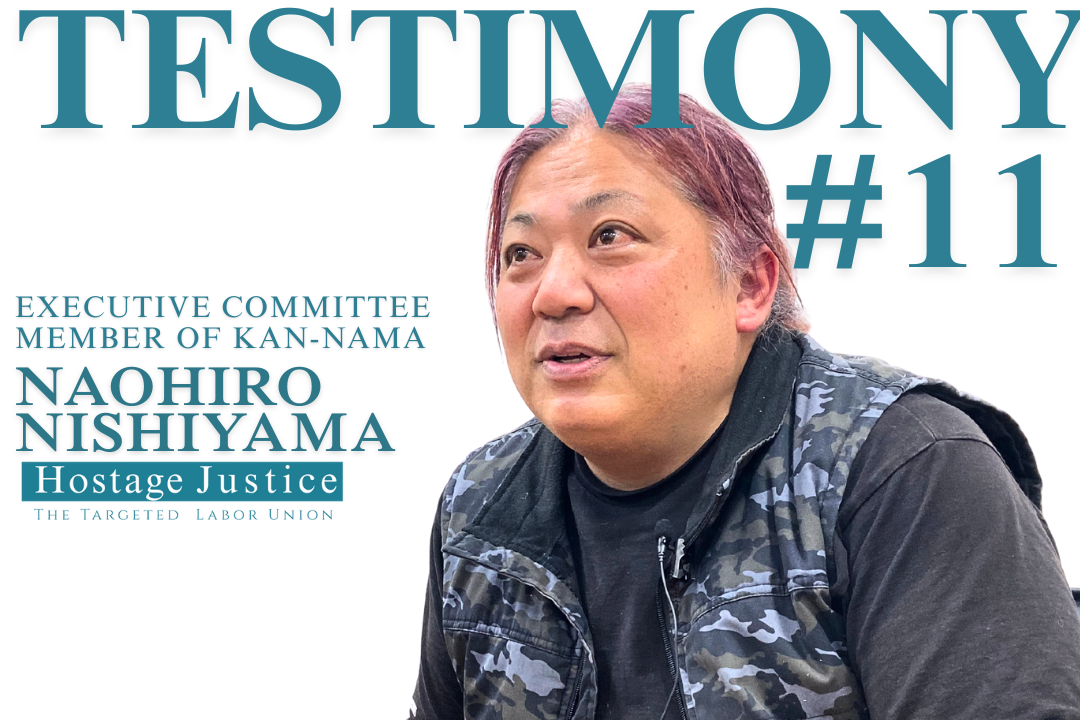
“Why Did You Go to Henoko?” the Osaka Prefectural Police Security Department Was Concerned About “Things That Were Inconvenient for the Government” / Naohiro Nishiyama, Executive Committee Member of Kan-Nama【Kansai Ready-Mixed Concrete Case Testimony #11】
2025.12.08 17:23 Makoto Watanabe, Nanami Nakagawa
Kan-nama is doing more than just raising wages and improving working conditions for employees. Furthermore, they participate in a number of social movements, including those that aim to end discrimination and oppose war. They are adamant that people in less powerful positions shouldn’t be sacrificed.
Naohiro Nishiyama, an executive committee member of Kan-nama, has been involved in anti-U.S. military base movements and solidarity with Korean labor unions.
He was first arrested by police in 2004, and was also arrested and detained during a large-scale criminal crackdown that began in 2018.
During this time, the Osaka Prefectural Police Security Division had been monitoring Nishiyama, and during questioning they tried to find out about his activities that were unfavorable to the government, such as protests against U.S. military bases.
Eight riot police
The first time I was arrested by police was in 2004.
At the time, negotiations for a Japan-Korea FTA (Free Trade Agreement) were underway between the two governments. Korean labor unions believed that increased Japanese imports would have a negative impact on employment in small and medium-sized firms. In Korea, around 100,000 people went on strike in opposition to the Japan-Korea Free Trade Agreement.
Korean labor unions came to Japan and held a protest rally in front of the Ministry of Foreign Affairs. Kan-nama has friendly relations with the Korean construction labor union. I studied in Korea for a year from 2003. We, the union members of Kan-nama, helped organize the rally in front of the Ministry of Foreign Affairs. Japanese civic groups also participated.
After the first day’s rally, we said “Let’s do it again tomorrow,” and left the scene. I folded up the flag and headed for the minibus. Then, the Metropolitan Police Department’s riot police came rushing towards me. Eight of them knocked me down and took me into custody. I was in charge of the rally, so I suppose I stood out to them.
Some attendees were shouting, “Let us cross, let us cross!” as they were leaving the protest because the police had blocked the crossing and they were shouting.
It was my first time being arrested, and I was shocked. Although I thought I would be released soon after being arrested, the lawyer who came to see me right after my arrest told me, “We don’t know when you’ll be released.” It was a bit unnerving. I was detained for 12 days.
The following year, in 2005, I was arrested by the Osaka Prefectural Police Security Department and detained for a year. I was accused of “obstruction of business by force” and “attempted coercion” for my negotiations with a ready-mix concrete company, and they asked me about my time studying abroad in Korea. They wanted to know if I had been involved in labor activism while attending school, and whether Kan-nama covered my living expenses. I guess they were concerned about the possibility of international ties being formed between labor unions.
Repeated police obstruction of justice
In 2014, construction began on a U.S. military facility in Kyotango City, Kyoto Prefecture, to deploy an X-band radar. X-band radar is a type of radar designed to detect ballistic missiles. There are concerns that the facility, intended to defend the U.S. mainland, could involve local residents and the Self-Defense Forces, sparking a public opposition movement.
In June 2015, three members of a citizens’ group who were protesting were arrested, and the office of Kan-nama was also searched. Protest rallies were often organized in Kyotango, and participants from Osaka took Kan-nama’s bus. Although the participants of the rally pay actual expenses such as highway tolls and gasoline, the police claimed that this was an “illegal taxi” and a violation of the Road Traffic Act.
We filed a lawsuit against the Osaka Prefectural Police, claiming that the forced investigation was wrong. On November 9, 2018, it was decided that I would appear in court as a witness on February 12, 2019.
However, about two weeks after the date for my witness examination was set, on November 21, 2018, I was arrested by the Osaka Prefectural Police for intimidation and obstruction of business. Although I was not present at the strike in Osaka by Kan-nama in December 2017, I was arrested for being an accomplice.
Due to the arrest by the Osaka Prefectural Police, the witness examination in the lawsuit against the police, which was scheduled for February 12, 2019, has been postponed and would be held at the Osaka Detention House on March 4.
However, I wasn’t able to testify as a witness at Osaka Detention House on March 4. This is because I was arrested by the Shiga Prefectural Police on February 18 and transferred from Osaka Detention House to Otsu Police Station. The Shiga Prefectural Police arrested me on suspicion of attempted extortion, even though I had simply distributed flyers calling for compliance with laws and regulations at construction sites.
I was subsequently released on bail on September 17, and was free for the first time in 10 months. The cancelled witness examination was rescheduled for November 15.
I thought that this time I would finally be able to appear in court for an examination, but on the day before, November 14, I was arrested by the Wakayama Prefectural Police. The union members of Kan-nama protested against the ready-mixed concrete company sending a former gang member to Kan-nama, and were arrested for attempted coercion and obstruction of business by force. I was also arrested for conspiring in the case.
In the end, I was not able to testify in the lawsuit alleging the Osaka Prefectural Police’s oppression in regards to the protests against the construction of a U.S. military X-band radar facility.
The Japanese Trade Union Confederation won’t fight the government
The police are on edge when it comes to protests against government actions, whether it’s the U.S. military bases or the 2019 summit in Osaka. While the Osaka Prefectural Police were questioning me, they didn’t ask me about the charges for which they arrested me, and instead asked me things like, “Nishiyama, why did you go to Henoko?” I once rode in a mixer truck to protest the construction of a new U.S. military base in Henoko, Okinawa, and both the Tokyo Metropolitan Police Department and the Osaka Prefectural Police dispatched riot squads.
I believe labor unions in Japan are currently in decline because they don’t fight against the government.
The Japanese Trade Union Confederation engages in “spring wage negotiations” with the government and gets wage increases from the Prime Minister.
However, that would only raise wages at large companies, and it wouldn’t have an effect on small and medium-sized companies, because they’re all being used as stepping stones.
Rights are something to be won.
[Reporter’s Postscript] The essence revealed in “Why the green head?” / Editor-in-Chief Makoto Watanabe
Kyoko Amakawa, a prosecutor at the Osaka District Public Prosecutors Office, asked Nishiyama the following questions during questioning.
“Why do you have a green head?”
Nishiyama dyes his hair in bright colors. It’s pink now, but it was green at the time. Prosecutor Amakawa probably just wanted an opportunity to start a conversation with Nishiyama, who remained silent, and she probably asked without any deeper intention.
However, I believe this question really gets to the heart of the matter. Whether it’s the police or the prosecutors, those who oppress others are accustomed to being part of the majority. Minorities who are different from them are perceived as “other.” This subconscious drives them to eliminate those who don’t go along with the majority.
Nishiyama is the opposite. He is constantly concerned about those who are excluded from the majority. During the interview, he expressed concern that homeless people would be evicted by the government in the run-up to the Osaka Expo.
International solidarity holds great potential as a way to fight against the majority in Japan. Kan-nama is in solidarity with the National Construction Workers’ Union of Korea. The Construction Workers’ Union is made up of approximately 50,000 members working in the construction industry. Nishiyama studied abroad in Korea for a year in 2003.
On January 9, 2019, Lee Young-chul, chairman of the Construction Workers’ Union, sent a letter of protest to Prime Minister Shinzo Abe through the Japanese Embassy in South Korea. This was shortly after the large-scale criminal crackdown on Kan-namae had begun.
“This large-scale criminal crackdown will have the effect of intimidating the legitimate union activities of not only solidarity unions, but also other labor unions and workers. We firmly protest this unjust criminal crackdown and demand the immediate release of the union members.”
Three years later, Yoon Sok-yeol became president of South Korea. He labeled the construction union a “construction union gang” and began cracking down on it. Kan-nama was also labeled an “anti-social force” and treated in the same way as gangsters.
However, in South Korea, Yoon was ousted in the face of the energy of civil society.
Japanese politicians may be afraid that the union activities of Kan-nama might gain strength through international solidarity and eventually spread to Japanese civil society.
(Originally published in Japanese on April 30, 2025. Translation by Mana Shibata.)
Hostage Justice: All articles