
 Newsletter
signup
Newsletter
signup
Husband Appears in Court Cord Tied Around His Waist, Wife Sits in the Front Row and Says, “I Have to Watch Closely” / Kan-Nama Member, Shigeki Kayahara and His Wife【Kansai Ready-Mixed Concrete Case Testimony #10】
2025.11.28 9:46 Makoto Watanabe, Nanami Nakagawa
Her husband came into the courtroom cord tied. As a wife, she couldn’t bear to see that.
Still, she didn’t look away. Her husband had done nothing wrong. From the front row of the gallery, she witnessed the crimes of the judiciary, which tried an “innocent man.”
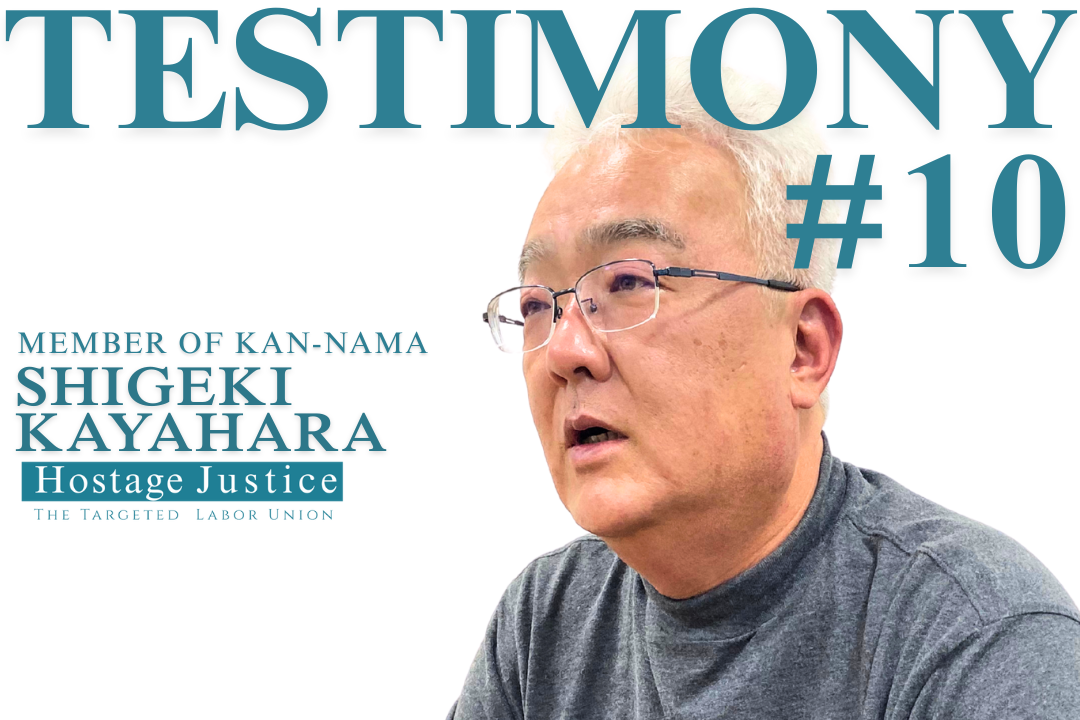
The tenth testimony recorded is from Shigeki Kayahara, a union member of Kan-nama and his wife.
Kayahara was arrested twice by the Shiga Prefectural Police on suspicion of “attempted extortion” and “obstruction of business by force” for his activities calling on construction companies to comply with the law. He was sentenced to two years and six months in prison (suspended for four years) by the Otsu District Court. He is currently appealing the decision.
Detective of the Shiga Prefectural Police Organized Crime Department believes his wife is also involved
At 5 a.m., the Shiga Prefectural Police raided our house. My wife and I were on the second floor. My mother was asleep on the first floor. My children were studying on the first floor and had fallen asleep. Our house is a small, 50-year-old house. They came thronging in with so many people, I was worried that it might collapse.
I hadn’t shared anything of Kan-nama’s activities with my family. They even checked the rooms of my wife and child who had no knowledge of the union activities. It didn’t matter that I assured them they had nothing to do with it. When the Organized Crime Control Department of the Shiga Prefectural Police, which looks into organized crime, arrived, they were rough. They even took the computer my child used for school work.
My mother cried when they took me away.
I learned that my wife had been contacted by the Shiga Prefectural Police after my incarceration. I made a complaint about this when I was being questioned by Shiga Prefectural Police Organized Crime Control Department Detective Hirotaka Mizukami. I have never discussed union activities with my wife, who is not a Kan-nama union member. It is a violation of human rights because we are two different individuals. However, Detective Mizukami simply smiled and remarked, “So she’s related.”
I believe their intention was to persuade my wife to say things like, “Quit the union” or “Plead guilty to the charges so the sentence will be lighter.” I’m grateful to my wife. If something like that had happened, it wouldn’t have been strange for her to have decided to leave home. I’m grateful that she remained strong-willed.
On the day of my final interrogation, Detective Mizukami blurted out, “I’ve been promoted to a managerial position.” I was like, “Yes, I see.”
“If we leave it as it is, it will all come back to us”
It was the day of my interrogation at the Otsu District Public Prosecutors Office.
I waited in the car with the police officers when I got to the district prosecutor’s office since I wasn’t called in right away. My handcuffs remained in place. The police officers on either side of me were large, much like me.
Four hours passed in this state, and my chest started to feel tighter and tighter. The police officer said, “You look pale.” I guess it was economy class syndrome. The police officer asked the prosecutor to start the questioning quickly and let me rest in a separate room.
However, Prosecutor Tada (then deputy prosecutor) said as soon as he entered the interrogation room, “I can’t stand it if you make such selfish demands.” Prosecutor Tada is the same person who said, “We’re going to eliminate the union.”
I spent seven and a half months in custody. The police and prosecutors used the possibility that I may destroy evidence and run away as justification for my detention. But I had a family, so I couldn’t possibly run away. Since they took everything that could become evidence during a search of my house, it was also difficult to destroy it.
Additionally, I told Detective Mizukami, “This is what’s called hostage justice, which leads to false accusations,” and “You can’t do this.” Arbitrary detention is forbidden by the Constitution. I replied, “The Constitution takes precedence, so it’s not okay no matter how much power you have.” Nevertheless, Detective Mizukami stated, “This kind of thing is normal.” He seemed brazen out.
I think the police and prosecutors are doing this to weaken Kan-nama. If you think about it normally, it’s a strange story. LDP lawmakers embezzle 20 million or 30 million yen and don’t get caught.
I believe that unions would typically disintegrate if they encountered this kind of oppression. But we have survived because members of other social movements like the anti-nuclear movement are supporting Kan-nama’s actions.
People came to support then-Chairman Kenichi Take virtually every week while he was detained at the police station. It was all done without any compensation. When I said “Thank you,” they replied, “If we leave the current situation as it is, it will all come back to us, so we are doing this for our own good.”
I was almost moved to tears. It is because of people like them that we have survived. I am convinced that people have supported us because we have been doing worthwhile work.
Wife: “How did they know my cell phone number?”
While my husband was in custody, the police called my cell phone. I didn’t answer the phone, but there was a voicemail. I was scared, “How did they know my cell phone number?”
When I went to visit my husband, a police officer asked me if I could drop by on my way home, but I declined because the people at Kan-nama had told me not to say anything.
My husband and I also exchanged letters. The one I remember most is one that said, “There are a lot of tiny insects in the detention center. What should I do?”
I found an image of a tick-like creature online, put it in a letter, and sent it to him. I wanted to show the police that there were many insects like this since I knew they would be reviewing the contents of the letter.
Tears flow as she saw her husband return home in a weakened state
I wasn’t told much about union activities at Ka-nama, but I knew my husband wasn’t doing anything bad. I saw him every day. If he had done something bad, I’d know because his facial expression would change.
I cried when my husband was released and came home. Someone from Kan-nama drove him home, but he looked a little deflated. His eyes were lifeless, like an old man who had been hospitalized. When I saw that, I got emotional.
During the trial, I sat in the front row of the gallery.
I didn’t want to see my husband come out with a rope around his waist, but I still thought I needed to watch closely.
The two prosecutors didn’t seem to be cooperating very well, and I was left wondering, “Is everything okay?”
The verdict was guilty, but rather than feeling frustrated, I wonder what will happen in the end. If they found him guilty and then later found him not guilty, how would they take responsibility?
[Reporter’s Postscript] The sharpness of the perspective, “If you’re going into a house, line up your shoes” / Editor-in-Chief Makoto Watanabe
When interviewing union members and their families at Kan-nama, we always end the interview by asking them, “Is there any message you would like to share?”
Kayahara’s wife said this as a message to the Shiga Prefectural Police.
“If you’re going into someone’s house, make sure you line up your shoes. You have to be mindful.”
The Shiga Prefectural Police stormed into her home at 5 a.m., and she said it was “awful” that they left their shoes scattered around. As the house was being searched, she lined up the police officers’ shoes.
I thought she had a keen sense.
She had not heard from Kayahara about the activities of Kan-nama, nor was she familiar with the rights of labor unions recognized by the Constitution. However, comparing their behavior to the things she values in her daily life, she realized, “These police officers are rude.” One thing leads to another. Her perspective symbolizes the recklessness of investigative authority.
It was also astute of her to look at her husband’s face and judge that “this man is not doing anything bad, he is doing the right thing.”
Although logic and knowledge are necessary, I believe that observing others using your five senses is a basic attitude that should take priority over those.
We are producing videos of this series of testimonies, hoping that more people will engage with the union members and their families of Kan-nama with all their senses.
(Originally published in Japanese on April 23, 2025. Translation by Mana Shibata.)
Hostage Justice: All articles