
 Newsletter
signup
Newsletter
signup
“The Country Is on the Verge of Being Knocked Out” – Tansa Obtains New Evidence
2026.02.24 16:01 Mariko Tsuji, Makoto Watanabe
About a year has passed since the first oral argument in the “State Funeral Document Concealment Trial” in which Tansa filed suit against the government.
What we are trying to prove in this trial is that the public documents that the government claims do not exist actually do exist.
However, after five rounds of oral arguments, the government is backed into a corner. Yoichi Kitamura, the head of the plaintiff’s legal team and a lawyer with a track record in cases involving freedom of the press, describes the government as “on the verge of being knocked out.”
The evidence that Tansa gathered and submitted through research, the litigation led by Tokyo District Court Presiding Judge Kenji Shinoda, who questioned the government, and the meticulous strategy of five lawyers from the Japan Civil Liberties Union, all of these have produced a synergistic effect.
Oral arguments are held in the Grand Bench, and are always full. The online petition has collected over 42,000 signatures.
Politics where everything is decided by cabinet decision and conceals information is rampant. This trial is a fight to protect the infrastructure of democracy. In order to gain the continued support of many citizens, we will report on the results of our work over the past year, starting with the question, “What is the State Funeral Document Concealment Trial, anyway?”
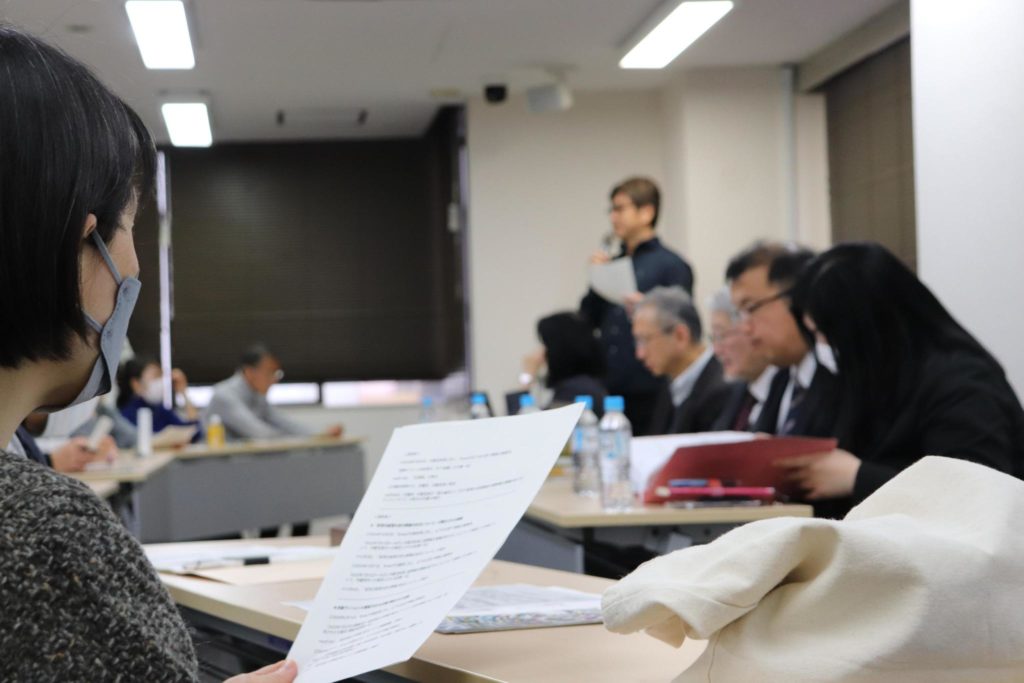
The fifth oral argument was held on December 23 2025. The briefing session afterwards was full. (Photo by Williams Jabril)
It all started with one page of “reception record”
On July 8, 2022, former Prime Minister Shinzo Abe was assassinated during an election speech.
Approximately two weeks later, on July 22, an important decision was made. The cabinet of then Prime Minister Fumio Kishida decided to hold a state funeral for former Prime Minister Abe.
We questioned this decision-making process.
Opinions were divided across Japan regarding the holding of a state funeral for former Prime Minister Abe. Some pointed out that it would violate the Constitution, which guarantees equality under the law and freedom of thought and conscience. There is no law that stipulates state funerals.
Normally, the bill would have had to be deliberated in the Diet by members of parliament elected as representatives of the people, but then Prime Minister Kishida decided to reach a conclusion through a cabinet decision without going through the Diet.
Instead of going through the Diet, then Prime Minister Kishida based his decision on the approval of the Cabinet Legislation Bureau, known as the “guardian of the law.”
At a press conference and in a Diet response on July 14, he stated the following:
“We are making this decision after thoroughly coordinating with the Cabinet Legislation Bureau. The government has decided that a state funeral can be held in this manner, based on the cabinet decision.”
What kind of discussions took place between the Cabinet Legislation Bureau and the Prime Minister’s Office? Tansa has requested the Cabinet Legislation Bureau to disclose all documents recording the discussions. This is a request under the Freedom of Information Act.
The Cabinet Legislation Bureau disclosed only one sheet of “reception record.”
Officials from the Cabinet Secretariat and Cabinet Office of the Prime Minister’s Office visited the Cabinet Legislation Bureau and held discussions over three days from July 12th to 14th. The names of the officials from the Cabinet Secretariat and Cabinet Office were not disclosed.
Regarding the content of the discussions, the only statement included was that “The Cabinet Secretariat and the Cabinet Office consulted us about holding a state funeral by cabinet decision, but we responded that we had no opinion.”
Tansa requested all documents that recorded the discussions. There is no way that a three-day discussion could be recorded in just one line, and there is no way that the Cabinet Legislation Bureau, the “guardian of the law,” would not have expressed any opinion.
It was clear that the Cabinet Legislation Bureau had violated the Freedom of Information Act and concealed documents.
The Prime Minister’s Office “discarded the documents”
Following the cover-up of the Cabinet Legislation Bureau documents, Tansa’s next strategy was to target the Cabinet Secretariat and the Cabinet Office. As can be seen in the Cabinet Legislation Bureau’s reception records, officials from the Cabinet Secretariat and the Cabinet Office attended the discussions from the Prime Minister’s Office. They must keep records. Since they had to report to then Prime Minister Kishida, they must have kept very detailed records.
However, only four pages of documents were disclosed.
This document is jointly signed by the Cabinet Secretariat and the Cabinet Office and is dated July 14. In other words, it is a document that outlines the policy decided upon after three days of discussions with the Cabinet Legislation Bureau, starting from July 12th. It does not record the process of the discussions, but only the conclusions.
The document is devoted to introducing examples of how funerals have been handled for former prime ministers and other important figures since before the war, and to referencing legal provisions. However, there was no solid justification for holding a state funeral for former Prime Minister Abe based on a cabinet decision.
We once again requested documents from the Cabinet Secretariat and the Cabinet Office that demonstrate the contents of the exchanges that took place between July 12th and 14th with the Cabinet Legislation Bureau.
The response was that the document did not exist. The reason given was as follows:
Cabinet Secretariat: Not created or acquired, or discarded, and no longer in possession
Cabinet Office: No administrative documents have been created and acquired, thus not in possession
This is to say the Cabinet Secretariat “either did not create the documents or discarded them,” while the Cabinet Office “did not create the documents.” The reason given was that “it was minor and would not affect policy decision-making.”
However, then Prime Minister Kishida stated at a press conference on July 14th, after the discussions with the Cabinet Legislation Bureau had concluded, that “it would be acceptable to hold a state funeral by cabinet decision.” He also made this statement in a subsequent Diet response. Saying that the documents do not exist because “they would not influence policy decision-making” is the same as saying “Prime Minister Kishida is lying.”
In January 2023, we filed a request for review to overturn this result. Under this system, the Information Disclosure and Personal Information Protection Review Board, which is made up of lawyers, former prosecutors, and professors, will deliberate on whether the “decision that the documents do not exist” was appropriate.
However, the review board deemed the results to be “appropriate” and did not change the decision.
On September 30, 2024, Tansa filed a lawsuit against the state demanding the disclosure of the documents. This marked the beginning of the “State Funeral Document Concealment Trial.”
Why did Tansa file the lawsuit? Editor-in-Chief Makoto Watanabe gave a statement about Tansa’s belief at the first oral argument in December 2024. You can read the full text.
Second Oral Argument: Requesting seven types documents that should exist
Tansa is the plaintiff in the lawsuit, but is also a reporter. Thus, we decided to bring the facts we have gathered through research and interviews into the trial.
What kinds of documents are actually generated when discussing important matters with the Cabinet Legislation Bureau? We interviewed people with experience in recording documents and disclosing information as bureaucrats.
As a result, seven types of documents were identified and the court asked the government to disclose them at the second oral argument in March 2025.
1)Position papers from the Cabinet Secretariat or the Cabinet Office submitted to the Cabinet Legislation Bureau
2)Documents or emails reported within the Cabinet Secretariat or the Cabinet Office containing questions or opinions from the Cabinet Legislation Bureau, as well as forecasts of when the Cabinet Legislation Bureau will reach a conclusion
3)Documents or emails created or obtained in order to answer questions or issues posed by the Cabinet Legislation Bureau and submitted or presented to the Cabinet Legislation Bureau
4)Emails exchanged within the Cabinet Secretariat and the Cabinet Office, and between the Cabinet Secretariat and the Cabinet Office, in preparation for the documents listed in the third item.
5)Emails exchanged with the the Cabinet Legislation Bureau
6)Documents or emails in which the Cabinet Legislation Bureau reports to the Prime Minister’s Secretary (or other person acting as an intermediary for the Prime Minister) about the status and content of meetings
7)Documents or emails received from the Prime Minister’s Secretary (or other person acting as an intermediary for the Prime Minister)
Tansa was given a boost by presiding judge Kenji Shinoda, who, during the second oral argument, called on the defendant to respond to Tansa’s demands.
“Formaly, when a ministry explained something to the Cabinet Legislation Bureau, the Legislation Bureau’s counsellors would ask questions. The ministry staff would take the questions home as homework, thus taking notes.”
“There are some parts that I can’t quite imagine. I think there are times when you’re concerned about the reactions of the counsellors, directors and director-general of the Legislative Bureau, so I would like an explanation that takes that into account.”
Third Oral Argument: Rejecting the government’s explanation “Keep the 5W1H in mind”
From the third oral argument in June 2025, it was held in the largest courtroom of the Tokyo District Court. This is because many people who had hoped to attend the hearings were unable to do so due to the full capacity. The main courtroom, which seats approximately 100 people, was almost completely filled.
At the previous oral argument, Presiding Judge Shinoda gave the government homework.
He could not imagine a situation where they would not take notes when consulting with the Cabinet Legislation Bureau, bringing back questions, or reporting to their superiors. He would like this point clarified.
It is rare for the presiding judge to intervene in a lawsuit in which the government is the defendant. Will the government respond sincerely? The state’s response attracted attention.
However, the government’s response was a complete failure.
1)On July 12, officials from the Cabinet Secretariat and the Cabinet Office visited the Cabinet Legislation Bureau. They showed the draft document and explained its contents, but the Cabinet Legislation Bureau did not make any specific comments on the spot.
2)Between July 12 and 14, the Cabinet Legislation Bureau contacted by phone. It was about amendments to the draft document that did not result in a change in the perspectives of the Cabinet Secretariat and the Cabinet Office.
3)Based on the phone call from the Cabinet Legislation Bureau, they amended the draft document and sent an email to the Cabinet Legislation Bureau.
4)On July 14, they received a call from the Cabinet Legislation Bureau, which responded that they had no comments regarding the amended draft document.
5)After receiving a response from the Cabinet Legislation Bureau, the document was finalized. The draft document was promptly discarded. Emails to the Cabinet Legislation Bureau were also promptly deleted.
The “draft document” mentioned in the response refers to the document regarding the implementation of a state funeral that the Cabinet Secretariat and the Cabinet Office brought to the Cabinet Legislation Bureau during discussions. After three days of discussions, this draft document was finalized on July 14 as the four-page document (mentioned above) titled “Regarding the Cabinet’s Decision to Hold a State Funeral for Former Prime Minister as a National Ceremony.” This led to then Prime Minister Kishida announcing that a state funeral would be held.
This response prompted Judge Shinoda to gear up and demand a detailed explanation from the government.
– What were the names and affiliations of the interviewed and those who attended the discussion?
– Who was the counterpart of the Legislative Bureau?
– What were the “amendments that do not result in a change in the perspectives of the Cabinet Secretariat and the Cabinet Office”?
He then criticized the government for continuing to avoid answering the question.
“Is it possible that the counsellor of the Legislative Bureau has made no comment whatsoever on the holding of a state funeral based on a cabinet decision, which is an essential matter?”
“In my limited experience, I believe it’s quite difficult to get approval from the Cabinet Legislation Bureau. I don’t think it can be resolved with simple tweaks to the grammar.”
“Please write with the 5W1H in mind.”
Fourth Oral Argument: Four people involved in the discussions identified
At the third oral argument, Presiding Judge Shinoda requested the disclosure of the names and affiliations of the officials who attended the consultations with the Cabinet Legislation Bureau. At the fourth oral argument in October 2025, the government finally revealed the names of the following four people:
Takayuki Nishizawa
Former Cabinet Counselor of the Cabinet Secretariat’s Cabinet Affairs Office, current Director of the Planning and Coordination Division of Ministry of Internal Affairs and Communication’s Administrative Management Bureau
Hiroshi Onmayashiki
Former Counsellor of the Cabinet Secretariat’s Cabinet Affairs Office, current Director of Fisheries Insurance of Fisheries Agency’s Fisheries Policy Planning Department
Mamoru Nakajima
Former Director of the Minister’s Secretariat of Cabinet Office’s General Affairs Division, current Deputy Director General for Okinawa Affairs of Minister’s Secretariat of Cabinet Office
Taro Tahara
Former Deputy Director of the Minister’s Secretariat’s General Affairs Division of Cabinet Office, current Assistant Counsellor of the Minister’s Secretariat’s Records and Archives Management Division of Cabinet Office
The government has submitted reports from these four people, detailing how they handled the records of their discussions with the Cabinet Legislation Bureau.
All four made the same claims in their reports.
“The documents and emails were discarded within three months of the end of the discussions.”
The government has so far made the following claims regarding discussions with the Cabinet Legislation Bureau.
“We threw away the documents because they were minor and didn’t affect policy decision-making. Or we didn’t keep records.”
The fact that all four of them “discarded documents and emails” within three months is in line with the government’s previous claims. They must have coordinated their stories.
However, following discussions with the Cabinet Legislation Bureau, then Prime Minister Kishida announced that a state funeral would be held. These four people are at what could be called “middle management” level, so before then Prime Minister Kishida could make this announcement, there must have been reports to various superiors in the relevant departments.
So, who else besides those four were involved? Presiding Judge Shinoda questioned the existence of people responsible for decision-making.
“Something that shows the structure of the deliberation team. For example, an organizational chart of the department. I would like an explanation on the team under which the deliberation was carried out within the Cabinet Secretariat and the Cabinet Office.”

A report from four people from the Prime Minister’s Office who participated in discussions with the Cabinet Legislation Bureau regarding the state funeral of former Prime Minister Shinzo Abe.
Fifth Oral Argument Part 1: The lie that “No one other than the four was involved”
The fifth oral argument was held on December 23, one year after the first.
Although Presiding Judge Shinoda was putting pressure on the government, the government remained unchanged. At the fourth oral argument, Presiding Judge Shinoda gave the government the homework of “clarifying the process of deliberation in holding a state funeral and the line for approval,” to which the government responded as follows:
“Due to confidentiality reasons, there were no other staff members involved in this matter other than the four of them.”
There is no way that a decision to hold a state funeral can be made by mid-ranking bureaucrats alone. This is an obvious lie.
This was debunked by Tansa’s defense team, who presented as evidence documents obtained through an information disclosure request after the filing a lawsuit.
The document Tansa obtained is titled “Regarding the Execution of the Funeral of the Late Shinzo Abe” and is from the Cabinet Secretariat and the Cabinet Office. It was drafted on July 20, 2022, and states, “Regarding the subject matter, we would like to ask if it is okay to request a cabinet meeting,” with approval given on July 21.
It lists the names of 56 people who made the decision to hold a state funeral through a cabinet decision. The list includes the names of then Prime Minister Fumio Kishida, Chief Cabinet Secretary Hirokazu Matsuno, and other senior officials at the Prime Minister’s Office. It also included the names of four people who the government said “exclusively considered the matter.
Fifth Oral Argument Part 2: The “Third Document” exposed
Another serious lie by the government was exposed during the fifth oral argument. Again, Tansa’s defense team presented as evidence documents obtained through an information disclosure request after the filing a lawsuit.
To date, the government has only disclosed the following two types of documents. The government claims that the rest were either discarded or not recorded.
1)One reception record (July 12-14, 2022, Cabinet Legislation Bureau)
2)Four-page document, “Regarding the Cabinet’s Decision to Hold a State Funeral for Former Prime Minister as a National Ceremony” (July 14, 2022, Cabinet Secretariat/Cabinet Office)
However, Tansa obtained a “third document.”
“Regarding the Funeral Format of Former Prime Minister Abe”
This document is one page and dated July 14, 2022, and is signed jointly by the Cabinet Secretariat and the Cabinet Office. Although it should have been disclosed along with the first and second documents, the government has lied and claimed that documents other than the two documents do not exist.
Why did the government disclose the third document in response to a request for information disclosure after the lawsuit was filed? Why are they still insisting in court that only two types of documents exist? The truth behind this is unclear.
However, when the first and second documents were disclosed, the request was for “a record of the three-day discussions,” while when the third document was disclosed, the request was for “a record of the report made within the Prime Minister’s Office about the three-day discussions.” Since the requests were worded differently on the surface, the disclosure results may have been different.
In any case, this is an act of providing evidence to the plaintiff, and it is difficult to understand.
There’s more state funeral documents
The third document, “Regarding the Funeral Format of Former Prime Minister Abe,” suggests something important: that there must be more documents beyond the three that have come to light so far.
The basis for this inference can be found in the document “Regarding the Funeral Format of Former Prime Minister Abe.” Along with examples of funerals for past prime ministers, it also lists three points of understanding from the Cabinet Legislation Bureau.
1)The Cabinet’s performance of state ceremonies is included in the exercise of administrative rights.
2)The current Cabinet Office Establishment Act clearly states that the Cabinet Office is responsible for “matters related to state ceremonies,” and it is clear from the law that the execution of “state ceremonies,” including state funerals, falls under the administrative rights.
3)If the government does not compel the general public to mourn, which a state funeral order would stipulate, there is no need for legislative action to provide a legal basis.
The key point is the third item. This understanding is not included in the four-page document issued by the Cabinet Secretariat and the Cabinet Office on the same day, July 14, titled “Regarding the Cabinet’s Decision to Hold a State Funeral for Former Prime Minister as a National Ceremony.”
All three items are points of understanding that were confirmed following discussions among the Cabinet Legislation Bureau, the Cabinet Secretariat, and the Cabinet Office held from July 12th to 14th. Why is the third item not included in the four-page document? The following is the possible reason:
In fact, there are detailed records of discussions with the Cabinet Legislation Bureau, including a discussion of the idea that “legislative action is not necessary if mourning is not compulsory.” However, when drafting the “Regarding the Cabinet’s Decision to Hold a State Funeral for Former Prime Minister as a National Ceremony” and the “Regarding the Funeral Format of Former Prime Minister Abe,” it was either forgotten to include this in the former document or deliberately omitted for other reasons.
Tansa’s goal is to take back public documents, which are “public property,” to the hands of the citizens. We are fighting to pressure the government to disclose all state funeral documents.
Witness examinations of those who participated in the discussions are expected to be questioned as witnesses in 2026.
(Originally published in Japanese on December 25, 2025. Translation by Mana Shibata.)
Democracy Behind Closed Doors: All articles