
 Newsletter
signup
Newsletter
signup
Okinawa investigation didn’t follow up on clues pointing to organized crime(39)
2025.12.10 17:30 Mariko Tsuji, Makoto Watanabe
While Tansa travelled to various countries to investigate digital sexual violence, Japanese police did not move to investigate an app that spreads nonconsensual, sexually explicit images despite potential link with organized crime.
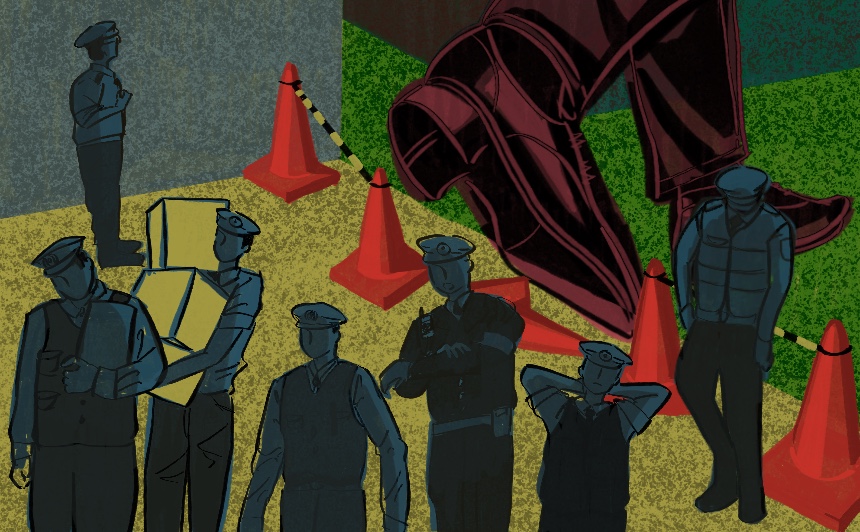
Illustration by qnel
There was a connection between Album Collection, an app that grossed millions of dollars in annual profits from the trade of sexually explicit images, and a drug smuggling case out of a US military base in Okinawa. That connection was a man named Shaun Hart.
Although William Leal was listed as CEO of Eclipse, Album Collection’s operating company, we had reason to believe that, in reality, it was Hart giving orders to Leal. In the Okinawa drug smuggling case as well, Hart was seen as the leader of the operation and was sentenced to 13 years in prison.
However, another individual may have been giving orders to Hart — Shimamura, whose name appeared in the drug smuggling case. By carefully reviewing the judgment document, as well as the evidence and record of court proceedings, we were able to discern the relationship between Shimamura and Hart.
Shimamura ordered Hart to destroy evidence?
We reviewed the trial records for the drug smuggling case at the Naha District Public Prosecutors Office.
The records included statements from the defendant (Hart) and other individuals involved in the case, photographs of the drugs and security camera footage used as evidence, and data on the import and export of the package that had contained the drugs. There was a significant volume of information, but it was prohibited to making copies or transcribe it verbatim. We took notes on the records in a meeting room, with the staff present.
In court, Hart explained that, before the drug smuggling case, he had imported a drug known as CBD, which is legal in Japan. As part of this business, he said that at Shimamura’s request he received and transported packages containing CBD via a private mailbox located within a US military base in Okinawa. However, a package received in June 2021 contained illegal drugs. Hart claimed that he believed the content to be CBD as per usual.
At the trial’s third hearing, Hart had the following exchange with his attorney, Taku Ooi. The text in parentheses was censored in the original document but has been added by Tansa based on additional reporting.
“In December 2020, a package that didn’t belong to you arrived via this route, correct? Who had ordered this package?” Ooi asked.
“(Shimamura) ordered it,” Hart replied.
“What is your relationship with this (Shimamura)?”
“He’s like a client. For CBD. He bought stuff like CBD from me.”
Hart only described Shimamura as a client.
However, we learned an important fact from speaking to Hart’s lawyer, Ooi.
In a series arrests related to the same case, individuals involved in transporting the drugs were taken into custody first, around June 2021. Hart was arrested in October of the same year, after an investigation by the Okinawa Prefectural Police discovered his involvement in the case.
Ooi also told us that Hart claimed “he had received instructions from Shimamura before his arrest to get rid of his mobile phone.”
If their relationship was merely that of vendor and customer, would Shimamura have instructed Hart to destroy evidence?
Safes in his apartment in Kofu City
There was another point of interest from the court records: the place where Hart was arrested.
Although Hart had lived in Tokyo, he moved to an apartment in Kofu City, Yamanashi Prefecture, in August 2021 — roughly two months after the drug couriers were arrested.
Just before his arrest, he had been staying at a hotel in Kofu under a different name. He was arrested as he left the hotel. Police also searched Hart’s apartment.
According to the police seizure report, Hart had been living in a three-bedroom apartment. It contained two beds, and there were safes in the closet and wardrobe. The police found cash and Adderall — a stimulant medication used in the US to treat ADHD — inside the safes. There were also signs that someone else had been in the room.
Didn’t inform US authorities, despite wanted list
A total of 10 people were arrested in connection with the drug smuggling case. Although Hart was identified as the ringleader, Hart himself was instructed by Shimamura to destroy evidence by disposing of his mobile phone.
Immediately after his accomplices were arrested, Hart moved from Tokyo to Yamanashi, where in his apartment police found cash, drugs, and signs of another person.
We believe this points to involvement in organized crime.
In fact, the Okinawa Prefectural Police’s investigation was conducted by its organized crime countermeasures division.
Together with the NHK reporting team, we interviewed Yuji Yamashiro, an inspector in the division.
In June 2021, the Okinawa Prefectural Police received a report from the US’s Naval Criminal Investigative Service (NCIS). The report was made because a civilian employee of the US military who had been receiving packages at a personal post office box within a US military base voluntarily disclosed that a package contained illegal drugs.
The prefectural police and customs authorities employed a technique called “clean controlled delivery,” replacing the drugs with a substitute and tracking the package. Police arrested individuals in Naha City who were scheduled to receive the package from the civilian employee. From there, they continued investigating up the chain, leading to the arrest of Hart, who had given instructions to the couriers.
However, the investigation was closed there.
Police did not investigate how or by whom the drugs were to be sold. The investigation “stopped at Kominami [Hart’s Japanese name],” Yamashiro told us.
Before he came to Japan, Hart had been arrested and was wanted in the US. The Okinawa Prefectural Police did not contact the US authorities about that either. Hart remains on the US wanted list even now.
Police negligence allows harm to continue
We have been searching for the true operators of Album Collection ever since we learned that nonconsensual, sexually explicit images were being traded in the app.
Working with white hat hackers to understand the app’s history and inner workings, we identified Kenichi Takahama and Keisuke Nitta as the individuals who had launched Album Collection’s predecessor apps. We traveled to Singapore to interview Takahama.
In March 2024, we conducted reporting in Hawaii, where Eclipse is registered. There, we realized that another individual — not Eclipse CEO William Leal — was at the center of the operation. The figure of Shaun Hart emerged, as well as that of a Japanese “semi-gangster.”
In order to better understand who this Japanese person was, we looked into the Okinawa drug smuggling case that Hart had been involved in. Although we learned of an individual named “Shimamura” who had instructed Hart to destroy evidence, there the trail went cold.
The same individuals are involved in both Album Collection and the Okinawa drug smuggling case. If the Japanese and US investigative authorities had conducted thorough investigations, they might have been able to discover whether both cases were the work of organized crime.
An ever-increasing number of people continue to be harmed by digital sexual violence while authorities only manage sloppy and half-hearted investigations.
In addition to Album Collection, various apps and online tools have become hotbeds of crime, as our next articles will reveal.
(Originally published on June 20, 2025.)
Uploaded and Re-Uploaded: All articles