
 Newsletter
signup
Newsletter
signup
Daikin Uses Misleading Media Reports; Residents of Kibichuo Town, Okayama, Issue Open Letter of Inquiry Regarding Health Effects of PFOA Contamination in the Town’s Tap Water
2025.09.17 13:45 Nanami Nakagawa
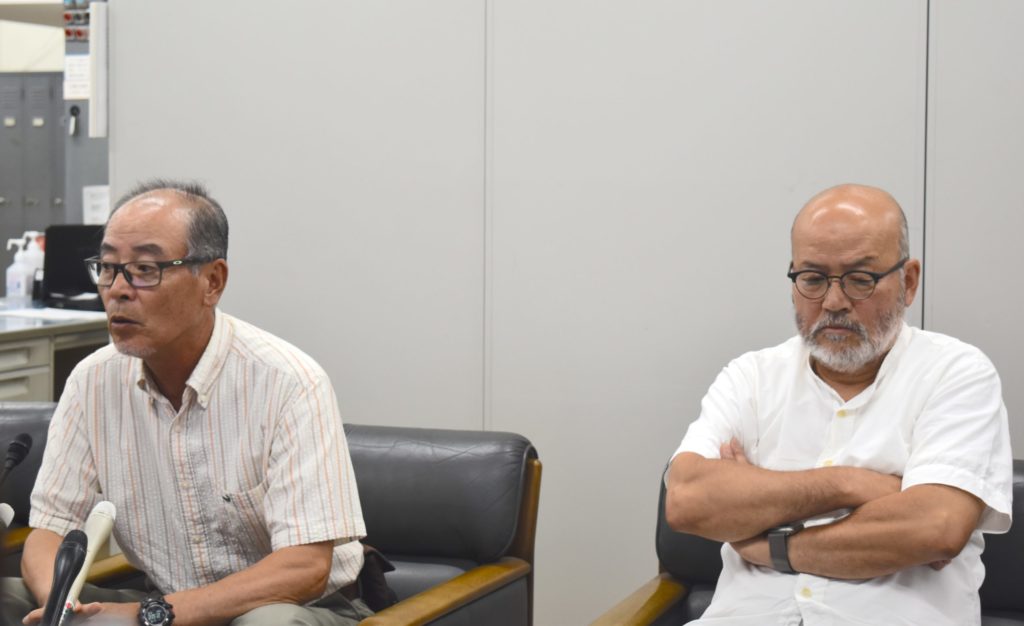
(Left) Representative Hiroshi Ogura and Zensaku Yoshida of the “Enjo Water Purification Plant PFAS Issue Group,” at a press conference at the Okayama Prefectural Government Office on August 18, 2025. (Photo by Nanami Nakagawa)
On August 18, residents of Kibichuo Town in Okayama Prefecture sent a questionnaire to Naofumi Takenaka, president of Daikin Industries, a company that manufactures PFOA.
The reason for this lies in the Daikin general shareholders’ meeting held in June. Director Yoshiyuki Hiraga gave the following explanation regarding the PFOA health survey currently being conducted in Kibichuo Town.
“The town published a mid-term assessment on the associated health effects, indicating that no distinct markers for PFOA, a form of PFAS, were discovered. We have recognized this through a few media reports.”
Daikin is causing PFOA contamination mainly in Osaka, and is taking advantage of the Kibichuo Town midterm report to reduce its responsibility as a company causing pollution.
Residents were shocked. The data analysis was sloppy, and the investigation is still ongoing. It cannot be said that there is no correlation between residents’ exposure to PFOA and health effects. It is misleading.
Why was such inaccurate information used by Daikin?
The administration and scientists disseminate information, leaving the residents behind. The media reports this information without question, ignoring the residents.
Although both organizations are supposed to stand on the side of residents and stop corporate pollution, they are currently dysfunctional.
Over 80% of children exceed US government guidelines
The contamination of Kibichuo Town’s tap water was discovered in October 2023.
The residents had been drinking water with 28 times the national drinking water guideline value for PFOA for at least three years. Of the more than 700 residents who underwent blood tests, 87% had levels above the “treatment required” level set by the U.S. government.
High exposure levels were also significantly higher among children aged 2 to 12, with 82% exceeding U.S. government guidelines.
Professor Takashi Yorifuji of Okayama University is continuing to conduct an analytical study on the relationship between PFOA exposure and health effects, at the request of the town.
Okayama University’s sloppy survey
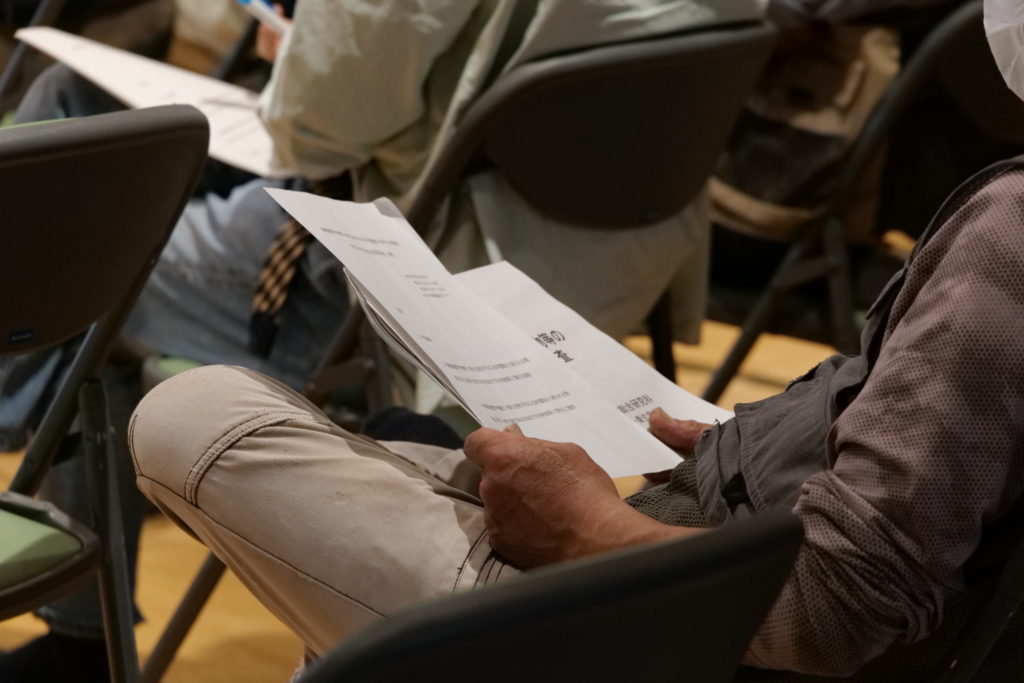
Participants pick up handouts distributed by Kibichuo Town at the Kibichuo Town public information session on May 18, 2025. (Photo by Nanami Nakagawa)
The problem came to light at a public information session held by the town on May 18, 2025.
Mayor Masanori Yamamoto gave a speech, and Professor Yorifuji gave a midterm report on the survey.
Professor Yorifuji explained using materials containing analytical data.
The study found that no clear differences were observed between people who drank tap water contaminated with PFOA and those who did not, based on a comparison of the contents of medical questionnaires.
However, there were several points in the explanation that were puzzling.
For example, people who regularly drank PFOA-contaminated water over a three-year period were considered to be in the same group as people who had drank PFOA-contaminated water at least once.
For the incidence of testicular cancer, one of the health effects of PFOA, data for women were included in the denominator.
To begin with, only approximately 700 of the town’s 10,000 residents took the blood tests, which is likely insufficient to provide any data from an epidemiological survey.
The media were not allowed in during the question and answer session. A press conference was held after the information session.
I asked a question, given that the report was based on sloppy data.
“If you present this kind of data, it will mislead viewers and readers into thinking that there are no health problems.”
However, Professor Yorifuji said, “Today, I have presented the provisional results, and I don’t think we can reach any conclusions.”
The blood tests are conducted by the town. Does the town think there is any problem with disclosing this data? When asked, Mayor Yamamoto replied:
“So I think Professor Yorifuji said that to avoid any misleading information.”
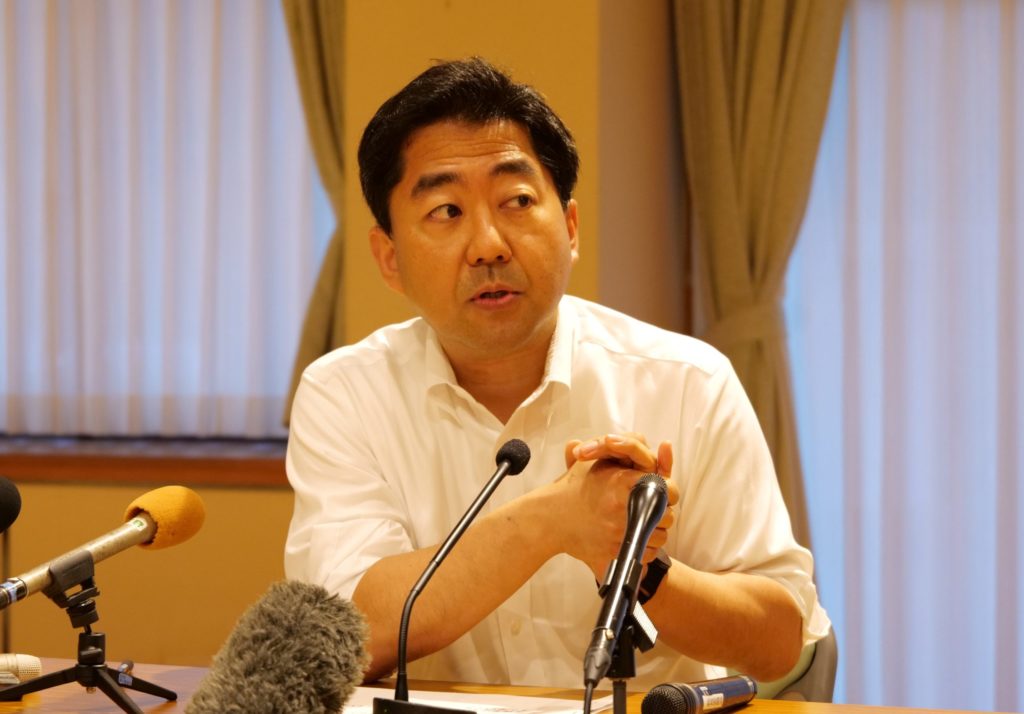
Professor Takashi Yorifuji of Okayama University at the Kibichuo Town public information session on May 18, 2025. (Photo by Nanami Nakagawa)
Prior to the press conference, there was a question and answer session with local residents, which was closed to the media, and I wondered if anyone had the same questions as me.
Zensaku Yoshida, a member of the Enjo Water Purification Plant PFAS Issue Group, which is made up of residents, pointed out the problematic distinction between those who drink the water and those who don’t, and the fact that the data is compiled based solely on the contents of medical questionnaires rather than blood test results, and said, “It’s all a numerical trick.”
Yoshida was also concerned about how the day’s events would be reported.
“Please do not give false information during the press conference.”
“The media will just write it as is. The government and the companies responsible are waiting for that to happen. They want to say that no matter how thick the blood concentration is, it has nothing to do with it. Please don’t give them that information.”
“I know I’ve said this many times before, but I would like the media to report this properly and not misunderstand.”
Despite Yoshida’s repeated emphasis, Professor Yorifuji did not change his explanation at the press conference, and Mayor Yamamoto tacitly accepted it.
Residents’ fears about the media proved true
Residents’ suspicions that the media will merely copy down the findings of Okayama University’s poor research proved to be correct.
The media reported the story exactly as the town explained it, with the following headlines:
Kyodo News (May 18, 2025)
Midterm analysis of PFAS testing in Okayama finds no clear health effects
Yomiuri Shimbun (May 19, 2025)
No clear effect found in midterm report of PFAS blood test results in Okayama
Asahi Shimbun (May 19, 2025)
“No clear difference” between drinking water and not drinking it: Kibichuo PFAS issue / Okayama Prefecture
Nikkei Shimbun (May 19, 2025)
“No clear effect” of PFAS found in Okayama Prefecture’s Kibichuo Town in midterm analysis of blood tests
NHK WEB (May 19, 2025)
Kibichuo Town: “No clear relationship has been found between PFAS and health effects for now”
KSB Setonaikai Broadcasting (May 19, 2025)
Kibichuo Town PFAS Issue: “No clear health effects found” – Town explains preliminary results to residents, Okayama
Mainichi Shimbun (May 20, 2025)
PFAS detected in Kibichuo town, no health effects found, town briefing held in Okayama
Since that day, Hiroshi Ogura, the representative of the residents’ group, has been approached by local residents who say, “It seems there are no health effects.” He became keenly aware of the impact that the media coverage was having.
Contact from Osaka
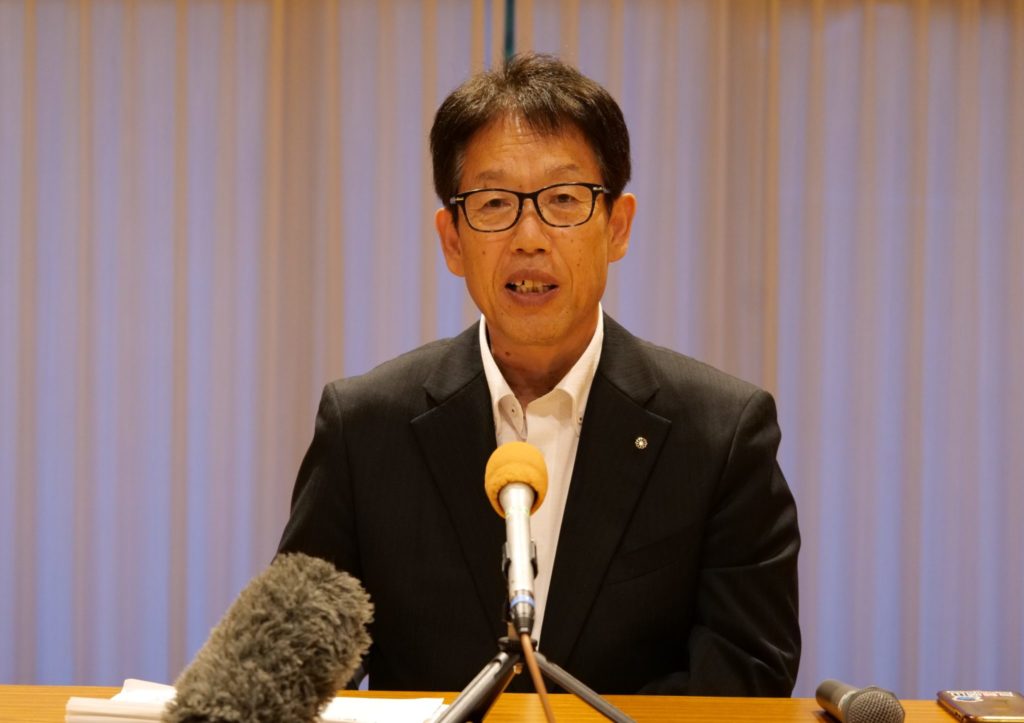
Mayor Masanori Yamamoto of Kibichuo Town at a Kibichuo Town public information session on May 18, 2025. (Photo by Nanami Nakagawa)
The month after the media reports, at the end of June, Ogura received a call from a residents’ group in Osaka that was working to address PFOA contamination.
“At Daikin’s general shareholders’ meeting, it was explained that blood tests in Kibichuo Town showed no health effects.”
The surprised members of the group looked up Daikin’s comments at the shareholders’ meeting.
As reported by Tansa, who obtained an audio recording, Yoshiyuki Hiraga, a director in charge of the chemical business, stated the following at the general shareholders’ meeting held on June 27 in response to a shareholder’s question about the health effects of PFOA:
“With the assistance of Okayama University, Kibichuo Town in Okayama Prefecture recently performed blood tests on its residents. The town published a mid-term assessment on the associated health effects, indicating that no distinct markers for PFOA, a form of PFAS, were discovered. We have recognized this through a few media reports.”
The residents cannot allow the media reports to become established as fact and be used by Daikin.
The residents’ group has asked Mayor Yamamoto and Professor Yorifuji to hold a press conference to supplement and correct the contents of the information session, but they have refused to comply.
On July 23, the residents’ group spoke directly to Professor Yorifuji. Professor Yorifuji said, “I don’t want the information I put out to be spread around with wrong intentions,” but added, “It’s not my role to hold a press conference, so please ask the town.” He has not even requested Daikin to correct the false statements.
However, when Ogura, a member of the residents’ group, met privately with Mayor Yamamoto on July 30, the mayor said, “I will post the town’s view regarding the midterm report on the town’s website.”
Nevertheless, the town’s website was never updated.
The residents’ group decided to hold a press conference themselves.
“Reporters have not studied enough”
Ogura and Yoshida visited the Okayama Prefectural Government Press Room on August 18.
Yoshida made some harsh comments to the press.
“To be honest, I think the reporters themselves have not studied enough.”
“Do you actually realize that the concentration in our blood tests was so high? It’s an incredible number, even on a global scale.”
“There is a significant pollution problem here. I would like you to study it a bit more. I’m not sure if you really feel a sense of crisis, but I would like you to ask questions or do research after studying it.
“As a victim, it is extremely frustrating that our data is being used in ways we did not intend.”
Ogura also added, “This is a matter of life and death,” and made the following appeal.
“We don’t want the victims of Kibichuo to be isolated and forgotten as if nothing happened. We ask media organizations to consider what might the victims be feeling because of the reporting.”
Ogura and Yoshida also revealed that as a group, they are asking the town and Professor Yorifuji to improve their investigation methods.
Seven questions for Daikin
The group disclosed that it had sent the following seven questions to Daikin, with a response deadline of August 31.
1. Is it correct that a statement was made at a stakeholders’ meeting that “the town published an assessment that no distinct markers for PFOA, a form of PFAS, were discovered”? Please review the minutes and provide us with the exact details.
2. If this is correct, please provide the name and position of the person who made the statement.
3. Please specify where you obtained the information that “the town published an assessment that no distinct markers for PFOA, a form of PFAS, were discovered.” If this information was obtained from a news organization, please provide the name of the news organization.
4. Please clarify whether this statement was made after confirming the details with Okayama University, which is conducting the investigation.
5. Please tell us to what extent your remark takes into account the actual situation in Kibichuo Town.
6. Since this was stated at the general shareholders’ meeting, can we take it as the company’s official position?
7. We have heard that your company has previously developed and manufactured PFOA, a type of PFAS. Is this correct?
The media ignores residents’ complaints
The day after the press conference held by the residents’ group, Kibichuo Town finally posted an “Additional information regarding the information session held on May 18, 2025” on its website.
However, they have not stated what was wrong with the information they provided. They have not pointed out any errors in the information provided by the media or Daikin. The misleading materials used in the session remain posted.
The results of the report of the information session held on May 18 are based solely on the analysis conducted up to this point, and are not binding in any way on the results of any future analyses.
Furthermore, the town believes that further analysis, related evaluations, and long-term health monitoring are necessary, and understands that this report does not “conclude that there are no health effects.”
The town will continue to investigate the health effects.
It is a hastily issued alibi-like statement following a press conference held by the residents’ group.
What about the media? I looked at reports about the press conference.
RSK Sanyo Broadcasting (August 18, 2025)
Regarding the PFAS detection issue in Kibichuo Town, residents are calling for the town to correct its information dissemination, which appears to have concluded that there are no health effects [Okayama]
RNC Nishinippon Broadcasting (August 18, 2025)
Kibichuo Town residents call for accurate information on PFAS issue
Miyazaki Nichi Nichi Shimbun (August 18, 2025)
Residents’ group requests improved accuracy of blood tests for PFAS in Okayama
Kyodo News (August 19, 2025)
Kibichuo Town’s opinion on PFAS survey in Okayama not conclusively determining no health effects
However, they did not make any corrections to their previous reports on the information session. Furthermore, they failed to address the concerns raised by the residents’ group about the media’s dissemination of information.
There were some media outlets that did not report on this press conference even though they reported the midterm report announced in May as it was announced by the town.
This indicates that neither the administration nor the media are conscious of how their false information is hurting the residents.
(Originally published in Japanese on August 20, 2025. Translation by Mana Shibata.)
Polluted with PFOA: All articles