
 Newsletter
signup
Newsletter
signup
“A Choice Between Food and Air Conditioning”: The Government Refuses to Restore the Cuts to Welfare Benefits that the Abe Administration Started, Despite the Supreme Court Ruling Them Illegal
2025.08.22 12:13 Nanami Nakagawa, Yuua Yukawa, Hiroko Sasaki, Kotaro Chigira
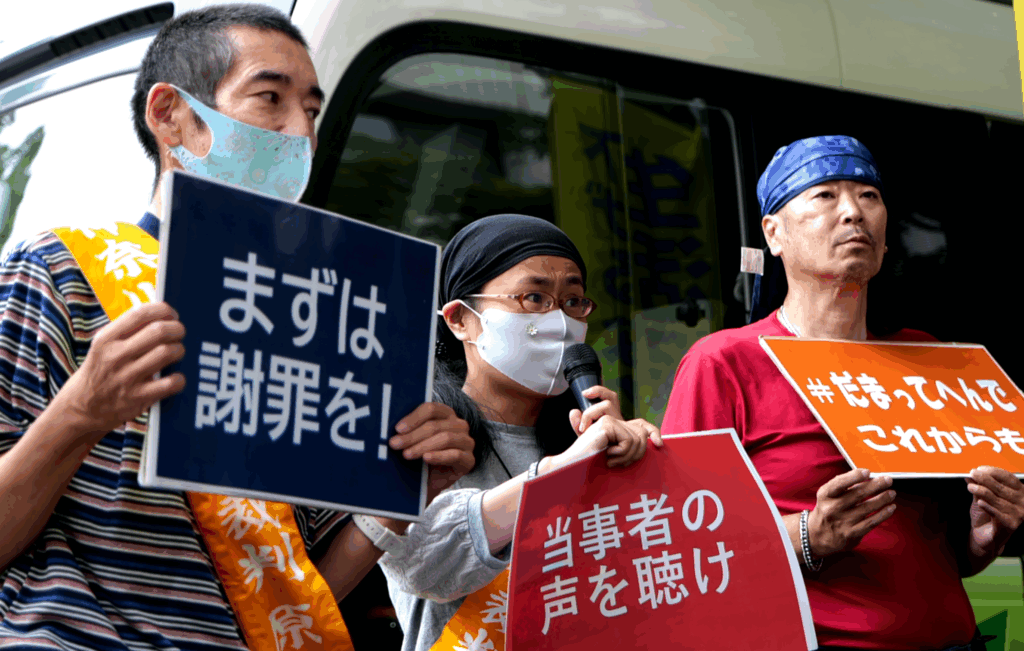
Plaintiffs in the “Fortress of Life Trial” protest in front of the Ministry of Health, Labor and Welfare in Kasumigaseki, Tokyo, on August 1, 2025. (Photo by Kotaron Chigira)
Drastic cuts in welfare benefits began on August 1, 2013, 12 years ago. It was reduced by up to 10%, an unprecedented reduction.
This was a key policy of the second Abe administration. Riding on public opinion that welfare benefits were unfair, the Liberal Democratic Party implemented this policy immediately after taking back power from the Democratic Party.
The basis for welfare benefits is Article 25 of the Constitution, which guarantees a minimum standard of wholesome and cultured living. Lawyers from across the country immediately stood up alongside welfare recipients and launched the “Fortress of Life Trial.”
The case went all the way to the Supreme Court, where the plaintiffs won on June 27, 2025.
However, the government has yet to offer compensation for the cuts in social benefits, more than a month after the Supreme Court’s decision. It hasn’t even apologized. The situation is still unlawful, and the administration is disregarding the courts.
The plaintiffs who are on welfare are expressing their concerns, saying, “This is not just our problem.” The percentage of non-regular workers has doubled to 40% over the nearly three decades of LDP-led governance, and more and more people are at risk of experiencing financial hardship.
When the Abe administration cut welfare benefits, it cited “falling prices” as the reason. Nevertheless, a court case revealed that this was an assertion based on falsified data.
Moreover, prices are currently high right now. Compensation for the reduction in welfare benefits needs to be implemented as soon as possible.
Why is the government so slow to act?
Given its enthusiasm for increasing defense spending and handing out money as election strategies, it is clear that the government is trying to maintain power at the expense of those in weaker positions.
The LDP initiated the scheme, the media got on board, and public opinion became heated
In March 2012, the LDP launched a “Project Team on the Public Assistance Issue.” Hiroshige Seko, a lawmaker who has stated that “the expansion of public assistance costs is outrageous,” was appointed chairman, and the team set out to “cut public assistance costs by 800 billion yen.”
The following April, Josei Seven, a magazine, reported that the mother of a popular comedian was receiving welfare benefits. Later, Satsuki Katayama, a member of the project team, revealed that the popular comedian was Junichi Komoto.
This fostered public opinion that it was wrong for a parent to receive welfare while her child was a popular comedian. Komoto apologized in front of the cameras and returned part of the welfare benefits his mother had received. The story was widely covered by the media.
The Lower House election was held in December of that year. At the time, the Democratic Party was in power. The LDP, aiming to regain power, pledged to “cut public assistance.”
In January 2013, the month after the second Abe administration was launched, it was decided to cut welfare, a drastic reduction of up to 10%.
The cuts began on August 1, 2013, affecting approximately 2 million recipients each year.
The LDP initiated the scheme, the media got on board, and public opinion became heated. That was the composition.
Even in the heatwave, the air conditioner is set to 29 degrees
Article 25 of the Constitution states, “All people shall have the right to maintain the minimum standards of wholesome and cultured living.”
However, if welfare benefits are cut by as much as 10%, it will be difficult to fulfill this right.
Shiho Takahashi of Atsugi City, Kanagawa Prefecture, began receiving welfare in 2010, when she was 27 years old.
She suffered from a mental disorder due to abuse she suffered from at the hands of her parents. A doctor told her that she would not improve unless she left her family, so she decided to live alone while receiving welfare.
However, three years later in 2013, the amount of the allowance began to be reduced, and life became increasingly difficult.
Her first concern was whether she would be able to continue the counseling she was receiving, which she was paying for entirely out of her own pocket.
Then it began to impair her daily diet. She couldn’t afford to eat out or buy packed lunches. When she wasn’t feeling well enough to cook, she couldn’t even go to a cheap fast-food restaurant. She could only afford a loaf of bread and some vegetable juice.
Her health has also deteriorated. Her residence is built of concrete, which becomes heated in the summer. Although the house has air conditioning, she may not be able to pay the electricity bill.
“I set the temperature to 29 or 30 degrees and wear only underwear inside the house.”
Even so, in July of this year, she suffered from heatstroke while indoors.
“Fortress of Life Trial”
Since 2013, the number of welfare recipients has increased nationwide. They, along with social security lawyers, have appealed for the reversal of unjust benefit cuts. This is the “Fortress of Life Lawsuit.”
Initially, the plaintiffs continued to lose cases in local courts. The government submitted evidence to the courts demonstrating that prices were falling and argued that the welfare cuts were justifiable.
However, the government’s data was produced using a calculation method that exaggerated the rate of price decline, and the base expenditure figures were based on the average figures for general households rather than those for households receiving welfare. The plaintiffs’ lawyers persisted to fight, pointing out the government’s fake data.
On June 27, 2025, the Supreme Court, Chief Justice Katsuya Uga, ruled that the government’s reductions in welfare benefits since 2013 were illegal.
Plaintiffs’ lawyers: “It is extremely strange that the illegal situation continues”
Nonetheless, the plaintiffs’ fight did not end there.
No compensation has been paid for the 12 years of cuts since 2013. No one has even apologized.
On July 1, Minister of Health, Labour and Welfare Takamaro Fukuoka stated at a press conference that he would “establish an expert committee.” This would involve external experts discussing the issue.
Following repeated requests from the plaintiffs, a meeting with the Ministry of Health, Labour and Welfare was finally arranged on August 1. However, the Minister did not attend. No officials at the section chief level or above participated, and instead, Yukio Abe, General Coordinator of the Social Welfare and Relief Bureau’s Relief Division, handled the meeting.
Abe stated, “It is disappointing that more than a month has passed since the ruling,” but did not offer an apology or discuss the details of compensation. Nothing has been decided, not even the contents of the expert meeting or when it will begin.
Even though the plaintiffs demanded that “an apology can be made without establishing an expert committee,” the government’s stance was that “a decision will be made based on the conclusions of the expert committee.”
Hiroki Bito, a lawyer and co-chair of the “Fortress of Life Trial” and a member of the plaintiffs’ group, made the following remark at a press conference after the meeting.
“The Ministry of Health, Labour and Welfare acknowledges that it is illegal, but the illegal situation continues. It is extremely strange.”
[Reporter’s postscript] Do you still call recipients “unfair”? / Reporter Nanami Nakagawa
An hour before negotiations with the Ministry of Health, Labour and Welfare were to begin, the plaintiffs protested in front of the ministry’s building.
They lined up on the sidewalk and expressed their thoughts towards the Ministry of Health, Labour and Welfare building.
“I have to live on 600 yen a day” (about 4 US dollars).
“We’re being forced to choose between food and air conditioning.”
“First, please apologize.”
It was lunchtime, between 12 and 1pm. Employees were coming out of the government building one after another. The Ministry of Health, Labor and Welfare and the Ministry of the Environment are in the same building, so I couldn’t tell which ministry they were from. Either way, they were people who worked for the ministry.
However, no one paid attention to the plaintiffs’ voices. No one stopped to listen, and many people just walked past and sneered at the people raising their voices as if to say, “They’re up to something.”
In stark contrast are the plaintiffs.
A man in his 50s living in Saitama Prefecture explained why he became a plaintiff:
“I thought it would be beneficial not just for me, but for everyone in society. Right now, everyone is struggling. We need to create a society where no one falls into poverty.”
Akira Sawamura, the plaintiff in the lawsuit in Aichi Prefecture, also thinks about the lives of others.
“I hope that people will use this ruling to make a variety of requests, including pay increases, pension increases, and student loan forgiveness. I hope they use it to address further concerns.”
Even though Sawamura and other plaintiffs have been subjected to many cruel words in the past, the words “for everyone’s sake” come out naturally.
Still, would you call welfare recipients “unfair”?
(Originally published in Japanese on August 1, 2025. Translation by Mana Shibata.)
Standalones: All articles