
 Newsletter
signup
Newsletter
signup
Japan Towards Ultranationalism
The Rise of Sanseito: Solidarity Across Positions and Occupations Is Needed to Stop the “Nazification” of Japanese Society
2025.09.11 10:26 Tansa
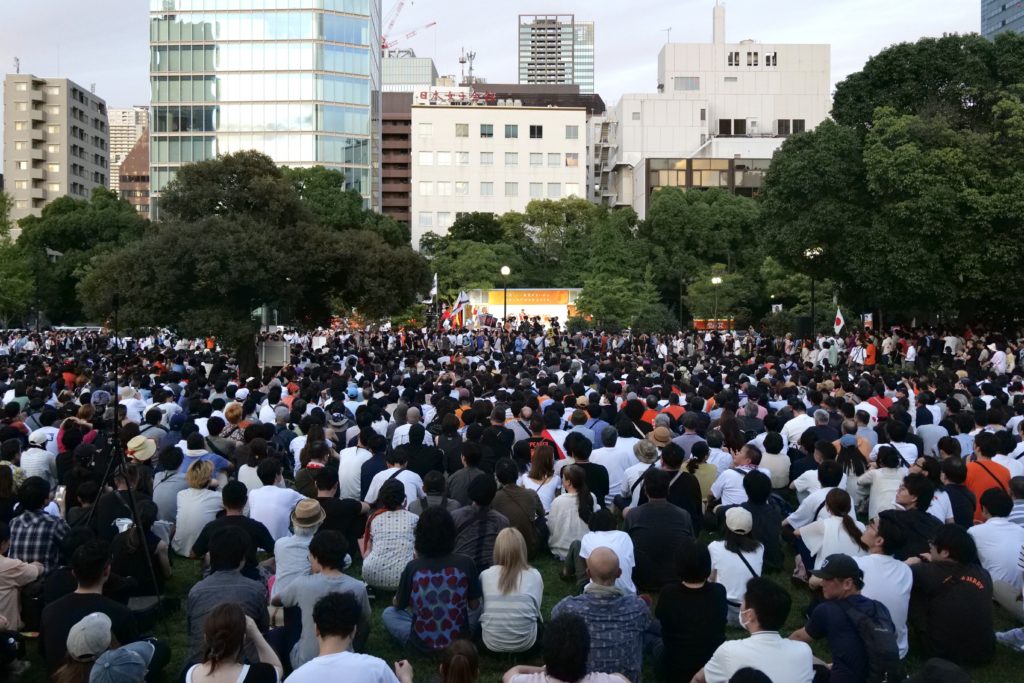
Supporters gathered at Shiba Park in Tokyo for the final speech of the Upper House election campaign by Sanseito on July 19, 2025. (Photo by Kotaro Chigira)
In the 2025 Upper House election, Sanseito made great strides, winning 14 seats.
The number of votes received through proportional representation was 7,425,053. This is the third highest number after the Liberal Democratic Party and the Democratic Party for the People, and is higher than the Constitutional Democratic Party.
On July 17 during the election period, Tansa declared that as a media organisation we oppose Sanseito.
There is criticism that a news organization should be neutral.
However, the role of journalism is to restrain runaway power in order to protect the lives and livelihoods of everyone. We believe that fearing criticism and overlooking authority that undermines basic human rights on the grounds of “neutrality” amounts to a failure to fulfill our responsibilities as a media organization.
Furthermore, we believe that everyone in Japanese society, regardless of their position or occupations, should stop the rise of Sanseito.
The Nazis, which were once a small and extremist political party, grew swiftly. This was motivated by widespread enthusiasm throughout society. Japanese society now is very similar to German society at the time.
Some may find it ludicrous to compare modern Japanese society to Nazi Germany, which massacred 5.5 million Jews.
But is that really the case?
Its dangerous “true character” hidden during the election
Many of Sanseito’s policies, like its appeal for food and medical safety, reassure people. In reference to its attitude toward foreigners, its leader, Sohei Kamiya, stated during the election campaign, “We simply say ‘Japanese people first,’ but we are not xenophobic.”
What about their true character though? Tansa has reviewed the words and actions of Kamiya and Sanseito over the past 19 years, and found many statements that are far from reassuring. This is as reported in our article, “A Comprehensive Look at the Numerous Statements That Promote Discrimination and War Made by the Representative of Sanseito, Sohei Kamiya, Over the Past 19 Years.” Here are some of the statements.
⚫︎We should value the Japanese bloodline that is passed down from ancestors to descendants. (“Sanseito Drill” 2024, Seirindo)
⚫︎The Japanese people are the “Great Treasures” of the Emperor, his precious children. The parent (the Emperor) watches over their children (the Japanese people), and the children work hard to repay their parent. (“Sanseito Drill” 2024, Seirindo)
⚫︎If the people lack the will to fight, even if Japan were to become nuclear-armed, the Prime Minister who would hold the launch switch would be too concerned with public opinion to press the switch. (“Monthly WiLL” August 2022 issue, WAC)
⚫︎Japanese boys should, even if it’s only for a short period of time, do a training camp where they feel their lives are in danger. (Sohei Kamiya Official Website “We want to fight! Japanese heading to overseas battlefields.” October 19, 2014)
⚫︎Sanseito aims to build a thriving society that can be run by Japanese people alone by increasing productivity through the use of AI and robots so that we do not have to rely on foreign workers. (“Sanseito Drill” 2024, Seirindo)
⚫︎Gender-free and LGBTQ are part of the ideological warfare exploited by communists to destroy hostile countries from within. (“Sanseito Drill,” 2024, Seirindo)
⚫︎Do women who leave their children in the care of others to go to work recognize the importance of the mother-child bond? (Suita City Council, September 12, 2008)
Furthermore, Sanseito’s proposed Constitution omits “equality under the law” and “freedom of thought and conscience,” which are guaranteed by the current Constitution. It stipulates that the requirements for citizenship will be “determined by law, based on the criteria that one’s father or mother is Japanese, one’s native language is Japanese, and one has a heart that cherishes Japan.”
However, Sanseito did not reveal these “true characters” during the election. It appears that they kept them secret in order to gain broad support.
On July 19, Sanseito held its final rally of the election in Shiba Park, Tokyo. 20,000 people gathered, and their supporters seemed completely at ease. Parents who came with their families told their young children, “I’m glad we came.”
The Nazis and Sanseito share a common belief in “bloodline”
The Nazis and Sanseito have something in common.
First, they place great importance on “bloodline.” The Nazi platform announced in 1920 included the principle of “bloodline,” which stated that only those of German blood could become citizens.
Nazi Adolf Hitler was prone to conspiracy theories, such as blaming Germany’s defeat in World War I on international capital, which he said was orchestrated by Jews behind the scenes. Kamiya of Sanseito also discusses Japan’s defeat in terms of conspiracy theories. According to Kamiya, Japan was trapped and plunged into the “Greater East Asia War,” and that for the West, bringing Japan under their control was “a long held desire since Columbus and Xavier.”
There are also many other commonalities, such as mothers staying at home to raise their children and the contempt shown towards sexual minorities.
However, the Nazis also suppressed their true intentions at times in order to gain widespread support from the people.
For example, in 1933, Adolf Hitler, who had just been appointed chancellor, appealed for world peace in the Diet. “We will strictly adhere to international treaties, resolve conflicts without the use of force, and protect the rights of other nations just as we protect the rights of our own nations.” That was what he said. Hitler’s speech was widely praised by the media.
The German people gave rise to the Nazis.
When Hitler was elected chancellor in 1933, the Nazis’ share of the vote increased from 2.6% in the 1928 national election to 37.3% in 1932 and 43.9% in 1933. In the subsequent year, Hitler assumed the title of “Führer,” merging the positions of chancellor and president. The majority of Germans backed Hitler after that. The German people themselves desired this, even though Hitler was a tyrant.
As we all know, the Nazis’ ensuing atrocities included invading Poland with the “Blitzkrieg,” initiating World War II, and slaughtering Jews both at home and abroad.
The background to the people’s support for Hitler was economic hardship, especially the Great Depression that was triggered by the crash of the New York Stock Exchange in 1929.
Why did Germans live in poverty? They entirely believed Hitler’s falsehood that Jews who were successful in business were to blame for the problem. German society itself became Nazi.
There is a diary written by a young man who describes his feelings at the time.
There was something different about the Nazis that had a mysterious power to fascinate and infatuate us.
It was a perfectly synchronized marching of young people waving flags waving, eyes fixated on the road, and beating drums. There was something overwhelmingly moving about this community.
However, I couldn’t understand why my father spoke of the Nazis without enthusiasm or pride, but rather with a sullen tone. He would tell us not to believe what they said, that they were wolves, that the Nazis were seducing the German people in a terrifying way. But my father’s words went unheard by us excited young people.
(From NHK’s “The Century of Color Films (4) – Hitler’s Ambition: People Entrusted Their Future to the Nazis”)
The danger of the LDP attempting to take advantage of Sanseito
We are not just wary of Sanseito. We are especially concerned by the fact that the current social and political situation in Japan resembles that of Germany during the rise of the Nazis.
At the time, there was a push in Germany to rebuild the strong Germany that existed prior to World War I. Former Japanese Prime Minister Shinzo Abe had also adopted the slogan “Reclaim Japan.” As Japan’s economic power dwindled, there was an increasing demand for the restoration of a “strong Japan.”
The political situation is similar as well.
Until Hitler became chancellor, Germany was governed by a minority government of several political parties. In order to stabilize the government’s foundation, a conservative party that valued German traditions brought in the Nazis, but instead the Nazis gained real power.
Japan is now a minority government led by the Liberal Democratic Party. To capitalize on the popularity of the “Japanese First” Sanseito during the Upper House election, the LDP pledged to “zero illegal foreigners.” The LDP and other conservative parties are attempting to integrate Sanseito in order to stay in power, which is not surprising.
Sanseito will not be able to establish a coalition government because it currently only has three members in the Lower House, but it may be able to join the government if it gains more seats. At that time, Sanseito might gain the initiative over other parties who attempted to exploit them.
Japan is similar to Germany at the time in that it is a society that is insensitive to basic human rights.
For example, abuse of foreign detainees at immigration bureaus is rampant, and “hostage justice,” in which investigative authorities detain defendants for extended periods of time in order to extract confessions, has become commonplace.
Persuasion, not attack
In principle, it is the role of the media to stop the abuse of power.
However, only a few media outlets are critical of Sanseito, and as a whole they are hesitant to do so.
Take the Asahi Shimbun, for example. In its “Tensei Jingo” column dated July 21, the day after the election, the newspaper did not mention Sanseito by name, but referred to it as “that party.” It expressed concern that xenophobia could lead to the collapse of democracy, concluding with the following:
“Am I overthinking this? I sincerely hope that you’ll laugh and say, ‘Your worries were completely unfounded.'”
The writer is just looking on from a safe height and thinking it’s someone else’s problem.
Haven’t the Japanese media learned the hard way during the war what would happen if they didn’t fight when it mattered?
It is our sincere hope that media organizations and individual journalists will join forces, regardless of their organizations or positions, as fellow professionals fulfilling their journalistic responsibilities.
We would like everyone in society to cooperate in preventing the rise of Sanseito.
There are many different ways of thinking, and they should be respected. However, we can all unite by protecting basic human rights regardless of nationality or origin. We believe that this is our responsibility as people who, through countless sacrifices, have a democratic society that values basic human rights.
There are some things we definitely want to avoid in such situations.
That is an attack on supporters of Sanseito. During the Upper House election, supporters of Sanseito were already being called “jojaku” (short for “people who have an information shortfall”).
We believe it is important to maintain a stance of “persuasion” at all times. Otherwise, Japanese society will be divided.
We once heard the following story from a former member of the Unification Church who had left the church.
When I decided to leave the Unification Church and was about to move out of my apartment, my parents came to help me carry my belongings, but some Unification Church leaders showed up too. They yelled, “That guy is Satan, you’ll go to hell!” But my parents said, “Not over there! Come over here!” I was confused, but in the end my parents’ determination won out.
There are some supporters of Sanseito who stubbornly believe in the party’s claims. At Sanseito’s rally for the Upper House election, which drew 20,000 people, the atmosphere was more “euphoric” than “enthusiastic.” No matter how much we preach about the lies and dangers of Sanseito, they may not understand.
Still, we believe that it is important to have the “determination” to think about others who live in the same society.
Tansa will continue to do its utmost to protect fundamental human rights, which are the pillars of the Japanese Constitution.
July 25, 2025
Tokyo Investigative Newsroom Tansa
(Originally published in Japanese on July 25, 2025. Translation by Mana Shibata.)
Japan Towards Ultranationalism: All articles