
 Newsletter
signup
Newsletter
signup
Japan Towards Ultranationalism
20,000 People in Ecstasy on the Final Day of the Election: Our Messages to Sanseito Supporters
2025.09.10 17:51 Tansa
July 19, 2025, marked the final day of campaigning for the Upper House election.
The rapidly growing Sanseito held its final speech at Shiba Park, overlooking Tokyo Tower, led by its leader, Sohei Kamiya. 20,000 supporters of all ages and genders gathered. Some families brought their children in strollers.
Representative Kamiya exclaimed, “Don’t you want to create an anti-espionage law?”, while Saya, Sanseito’s candidate for the Tokyo electoral district, exclaimed, “Make me your mother!” Supporters cheered with ecstatic looks. A parent told their child, “I’m glad we came,” on the way home.
People who opposed Sanseito also gathered. They chanted, “Stop discrimination!” and “It’s just like the Nazis!” but were met with retorts from Sanseito supporters, who told them to “study more” and “you have a bad personality,” or even laughed at them.
If Sanseito gains control, Japanese society will crumble. There is a probability of creating many victims. Regardless of how excited its followers are, Tansa will continue to cover this as a news organization and oppose Sanseito.
Why can’t we allow Sanseito? In this article, each member of Tansa writes about their own experiences.
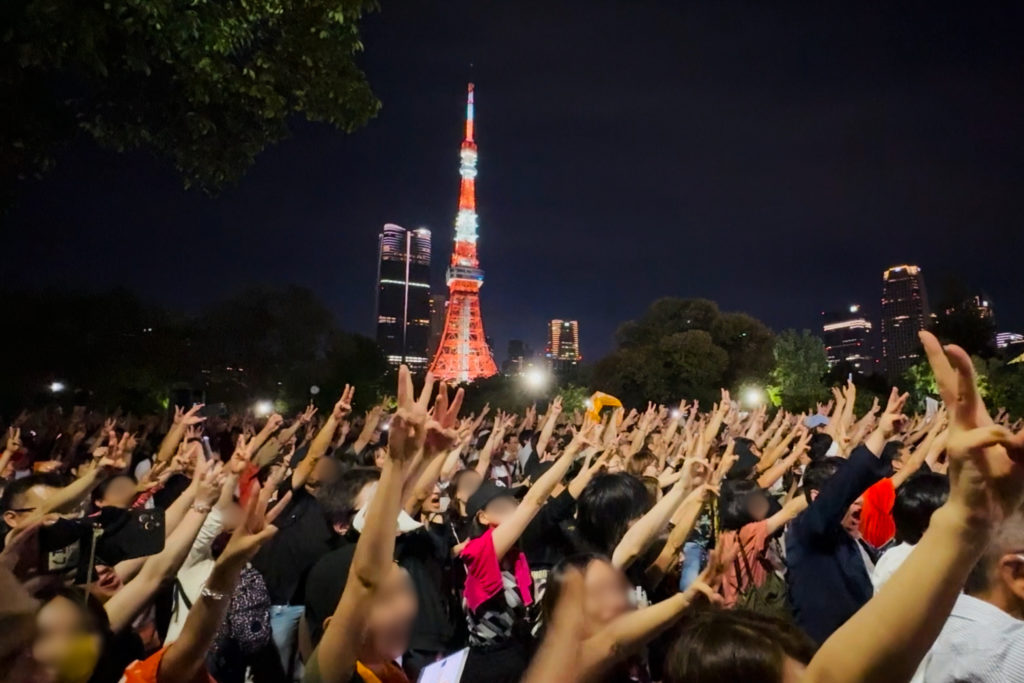
Supporters of Sanseito gathered at Shiba Park on July 19, 2025. (Photo by Makoto Watanabe)
Are you afraid of children just the way they are? / Reporter Mariko Tsuji
I was short as a child. For the six years of elementary school, I was always at the front of the class in terms of height.
At school, we weren’t allowed to leave any food on our lunch trays. If I couldn’t finish it in time, I had to continue eating alone while my classmates cleaned up. I was finally allowed to stop eating when afternoon class started. It was so humiliating that it brought tears to my eyes.
During the sports day, we had to practice marching as a group. Everyone had to wave their hands at the same angle and raise their knees to the same height. The teacher scolded me, telling me to move my body more than the others. But the idea of moving in perfect unison with everyone else felt unpleasant to me, so I didn’t want to do it.
Looking back, the children around me were all unique and diverse in terms of body size, physical strength, appearance, home environment, capability, important things, and thought. But we still received the same education in the same classrooms. I’m sure there were other children who struggled just like me.
Sanseito has little intention to respect freedom, and this is clearly evident in their approach to educating children.
The party’s proposed Constitution defines education as follows:
“Education in the Japanese language, classical reading, history and mythology, moral training, martial arts, and political participation shall be compulsory.”
“The Imperial Rescript on Education and other imperial edicts, patriotism, food and health, local rituals and great men, and traditional events must be respected in education.”
Both of these bills emphasize totalitarianism, placing the Emperor and the state above all others, and do not guarantee the rights of children as in the current Constitution.
Children already suffer because they are different from others in today’s society.
What if the Constitution also stated the state of mind? Won’t many children realize they can’t survive in such a society?
Representative Sohei Kamiya has previously stated, “If children are given the right to be themselves, then education and discipline will no longer be viable.”
The reason he fears children being themselves is because they cannot be subjugated.
Children, and people in general, should not be subjugated. Freedom is the most important thing.
Stopping the daily fear of LGBTQ+ people through speech / Staff Yuua Yukawa
One night during the election, on the train, the person next to me was viewing a short video of Sohei Kamiya. I’ve seen this scene several times and still can’t get used to it. Every time I see it, my body stiffens. In the crowd of people agitating in front of the station, I heard loud comments urging discrimination and exclusion. This was the first time I’ve seen an election like this.
I have friends who are LGBTQ+, and I’ve heard more and more of them say they’re afraid to walk outside.
“The person sitting next to me or passing by me might be wishing I’d disappear.”
There is a reason for this fear. On July 11, 2023, Kamiya stated at a lecture sponsored by the Sankei Shimbun, “We don’t need LGBT.” In the book “Sanseito Drill” published by Seirindo in 2024, which Kamiya edited and wrote, he wrote, “LGBTQ and the like are one of the ideological warfare exploited by communists.”
In addition to Kamiya, other members of Sanseito have also opposed the Promotion of LGBT Understanding Act in the Diet, claiming it is “unnecessary.” Several videos opposing the law have been uploaded to the party’s official YouTube channel, some of which have been viewed 280,000 times. This indicates that a large number of people support the party.
The actions and words of Sanseito and its supporters send a message of oppression to LGBTQ+ people, warning them to continue living quietly in obscurity, as they have done until now.
However, numerous media outlets have published such discriminatory remarks as news headlines without providing any criticism or analysis. This has made me upset, which is why I am writing this piece as a member of Tansa.
LGBTQ+ is not an ideology or a campaign; it is a group of people who exist in the present. Their existence is disregarded, labeled “unnecessary,” and eventually excluded. Just going out, having a simple conversation with someone, or browsing through a social media timeline can bring up discriminatory language. There are people right next to us who are driven to the brink by these words every day.
Although words have the power to kill, they may also save lives. I wish to protect the lives of everyone who is alive here now. I am going to fight with speech, exhausting all words.
Discrimination is not merely one opinion among many. Ignoring it in silence is complicit in discrimination rather than neutral.
“I respect Japanese people like you” – To avoid betraying the words of a friend / Videographer Kotaro Chigira
I want to be proud of being born in Japan, but I can’t achieve that by turning a blind eye to our past and glorifying it.
I made a friend from Singapore while I was a college student. I told him, “I’ve never been to Singapore, but I’d like to visit the memorial for those who died during the Japanese occupation someday.” He squinted and remained quiet for a long time. He said, “I admire Japanese people like you who study history.” His family members perished in the Japanese military’s Sook Ching massacre.
“The Japanese military was humane from an international perspective,” “Japan liberated Asia from the Western powers” –Sanseito glorifies this country’s past and trumpets its claim to “restore Japanese pride.” How wonderful it would be if these were true. When you’ve lost confidence, when life isn’t going well, such sweet words seem to slip through the cracks in your heart and restore your confidence. There are times when I, too, want to believe them.
However, I am aware that this is untrue. Numerous innocent civilians were killed and sexually assaulted by the Japanese soldiers in Okinawa, China, and Southeast Asia. The spirits of those who lost their lives are crushed when this history is ignored.
I would have been ashamed if I hadn’t known about the Sook Ching massacre in Singapore. My friends would have been disappointed if I had said, “The Japanese military was humane.”
The preamble to the Japanese Constitution states: We desire to occupy an honored place in an international society striving for the preservation of peace, and the banishment of tyranny and slavery, oppression and intolerance for all time from the earth.
I refuse to ignore history. I will strongly reject war and discrimination. By doing so, I aspire to become a Japanese person who is respected worldwide and “occupies an honored place.” So that I do not betray the words of my friends.
From a grandmother who experienced the war, “You must never discriminate” – Reporter Nanami Nakagawa
When you open the website of Sanseito, the first thing you see is a photo of a young child.
As you scroll down the page, you will come across the party’s catchphrase, “Japanese First.”
I think it’s ironic.
I started learning the piano when I was five years old. We lived in a public housing complex in Osaka and my mother worked constantly. We weren’t a wealthy family, but she let me take piano lessons which was the only extracurricular activity I got to learn.
Once a week, I had private lessons at my teacher’s home. My teacher was a Korean woman living in Japan named Oh.
I always obeyed my mother’s strict instruction to “always arrive five minutes early.” I always killed time by looking through the teacher’s bookshelf. It was lined with sheet music, biographies of great people like Helen Keller and Edison, and books in Korean. Next to the bookshelf was a koto (harp) that was taller than I was. I noticed Hangul characters on the back. When I asked the teacher, “What does it say?” she said, “It’s my name,” pronouncing the Hangul characters. I was thrilled to learn Korean for the first time.
One day, my mother, who works at a hospital, said, “Korean patients are troublesome.”
After that, whenever a news program reported that a person of Korean nationality had been arrested, she would say, “Koreans are scary,” and when she found out that our neighbor was from the Korean Peninsula, she would say, “Do not talk to that person.”
When I said, “Ms. Oh is also Korean,” my mother replied, “Ms. Oh is the only good Korean.”
I didn’t understand. When I asked, “What is wrong with others?” she simply replied, “Because Ms. Oh is a kind person,” and that was the end of the conversation. Even as a child, I wondered if Oh’s family and friends were bad people, and Oh would be sad if she heard my mother.
Above all, I didn’t like my mother, who frequently spoke ill of Koreans.
When I told my grandmother about this, she said, “That’s called discrimination. Grandma took refuge in Incheon, South Korea, during the war. If we don’t all get along, there will be another war. You should never discriminate.”
When I became an elementary school student, I was able to tell my mother, “You can’t discriminate!”
Despite its promises to be “for the sake of children,” Sanesito is causing great emotional distress to children. It teaches children to discriminate. Furthermore, Article 14 of the Japanese Constitution has been removed from its proposed version.
“All of the people are equal under the law and there shall be no discrimination in political, economic or social relations because of race, creed, sex, social status or family origin.”
I don’t want anyone, including the children of Sanseito supporters, to feel the way I did in the past.
What’s wrong with mothers going out to work? / Editor-in-Chief Makoto Watanabe
I could feel my blood boiling when I heard Sohei Kamiya’s words.
On September 12, 2008, when he was a member of the Suita City Council in Osaka, Kamiya said the following in the assembly:
“I wonder whether women who leave their children in daycare to go to work are aware of the importance of the relationship between mother and infant.”
This remark was made in relation to the increasing number of children on waiting lists for nursery schools in Suita City. He claimed that the number of children on waiting lists is increasing because many women go out to work even though it is important for children to be with their mothers.
My mother worked really hard from morning till night, ever since I was a child. We didn’t spend much time together, but I never resented her. I respected her.
I had friends whose mothers stay at home and hold birthday parties for their children, making fried chicken and cakes to entertain them. I used to feel a little envious of them, but it was a trivial matter. When I attended the birthday party and was treated to lots of fried chicken, my mood completely improved.
Some of my friends did not live with their parents. They attended elementary school from a foster home. On school open days, staff from the foster home would visit each child’s class for about 10 minutes. I remember my friends exchanging glances with the staff happily as they entered the classroom.
Kamiya probably believes that it is important for mothers and children to spend time together, otherwise it will have a negative impact on the child, but it is disrespectful. It is disrespectful to both mothers and children, as well as to the staff at foster homes and fathers in single-parent families.
The Nazis once established schools to train “good wives and mothers,” where women received training in child-rearing, cooking, and agriculture.
The fact that these Nazi institutions were founded on a limited perspective of women is not the only thing that makes them horrifying. It was intended that women would bear and raise “excellent” children who would be of service to the state, and that these offspring would later serve the state. This terrifies me.
On its website, Sanseito glorifies the wartime kamikaze pilots as heroes. The party’s proposed Constitution states that “the people have an obligation to protect Japan for future generations.” Supporters of Sanseito should be aware that this poses the risk of a resurgence of the Nazis.
(Originally published in Japanese on July 19, 2025. Translation by Mana Shibata.)
【List of articles in the series “Would you still choose Sanseito?”】
Japan Towards Ultranationalism: All articles