
 Newsletter
signup
Newsletter
signup
Japan Towards Ultranationalism
The Dangers of the Sanseito’s Proposed Constitution: “Myth Education” and “Military Trials” Are Included, While “Equality Under the Law” and “Freedom of Thought” Are Not
2025.08.21 12:20 Tansa
What kind of country does Sanseito want Japan to be?
This is clearly evident in the Constitutional Draft of Sanseito. It was published in May 2025, just before the Upper House election, as a “draft for new Constitution” rather than a “draft for constitutional amendment.” According to Sanseito’s website, it took two years of extensive discussions with party members across the country to come up with the draft.
While the current Constitution is made up of a total of 103 articles, the proposed Constitution only has 33. It is not only thin in substance, but also hardly worthy of being called a Constitution. While a constitution is essentially a set of promises that the people make the state power abide by, the proposed Constitution is the opposite. It places emphasis on the obligations that the state power imposes on the people.
Moreover, there are many statements that make it seem as if the hands of the clock have gone backwards. The preamble reads as follows:
“The Emperor has ruled the country since ancient times, and he cherishes the people and prays for their peace and happiness. The people in turn revere the Emperor, and the entire nation lives together, helping each other like a family. He shows the way public authority should be, and the form of politics that places the people at the heart is the unwritten constitutional order. This is the Japanese national polity that continues to this day.”
Significantly reduced rights
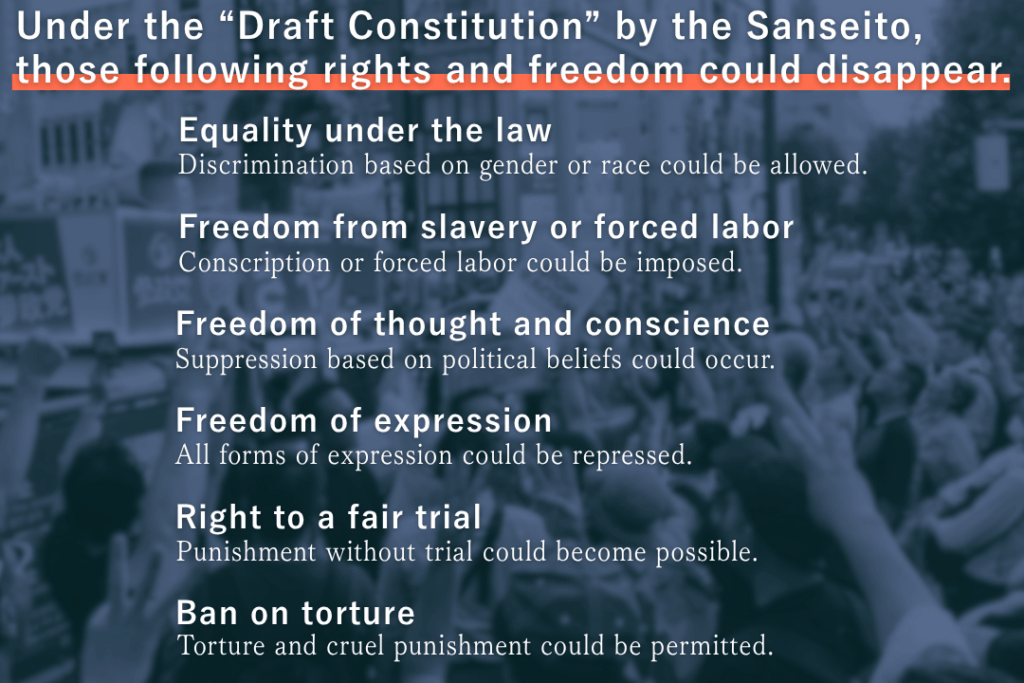
As pointed out in an article in the Mainichi Shimbun published on July 16, titled, “Our ‘rights’ erased in the proposed Constitution by Sanseito, even though they are present in the current Constitution,” the proposed Constitution leaves out the number of rights of the people, who are supposed to be sovereign.
First, there is no equality under the law as stated in Article 14 of the current Constitution. This encourages various forms of discrimination.
There is also no “freedom of religion” as stated in Article 20 of the current Constitution. Article 1 states that “The Emperor is a sacred being who prays for the happiness of the people and shall not be violated.” Does this mean that religions that worship anyone other than the Emperor are not permitted?
There is also no “freedom of residence, movement, choice of occupation, emigration to a foreign country, or renunciation of nationality” as stated in Article 22 of the current Constitution. Will the state also decide where people should live and what they should do?
There is also no “right of workers to organize, bargain, or act collectively” as stated in Article 28 of the current Constitution. Will it be impossible to join a labor union and demand higher wages and improved working conditions?
There is also no “freedom from bondage and involuntary servitude,” as stated in Article 18 of the current Constitution. Will people be forced to work or be conscripted?
Various obligations imposed
On the other hand, there are many things in the proposed Constitution that are not in the current Constitution.
For example, the role of the press is positioned in the chapter on “protecting the nation,” which deals with national defense, and there is a provision that assigns the press the role of “Imperial Headquarters announcements” that were in place before the war.
“The media has the duty to report impartially and fairly on national policies” (Article 16, paragraph 2).
Regarding national defense, there is also this article:
“Military courts shall be established, the composition of which shall be determined by law” (Article 20, paragraph 5).
It seems as though education has reverted to prewar times as well.
“Education in the Japanese language, classical reading, history and mythology, moral training, martial arts, and political participation shall be compulsory” (Article 9, Paragraph 3).
“The Imperial Rescript on Education and other imperial edicts, patriotism, food and health, local rituals and great men, and traditional events must be respected in education” (Article 9, paragraph 4).
There are articles that are typical of Sanseito, emphasizing lineage and “Japanese First.”
“The requirements for citizenship shall be determined by law, based on the criteria that one’s father or mother is Japanese, one’s native language is Japanese, and one has a heart that cherishes Japan” (Article 5).
“Land is public property and may not be transferred to foreigners or foreign capital” (Article 19, paragraph 2).
“Foreigners shall not be granted the right to vote. Naturalized persons are not allowed to hold public office until three generations have passed. The conditions for naturalization shall be determined by law, taking into account public safety and one’s understanding of the national character” (Article 19, paragraph 4).
Is it truly acceptable to give Sanseito the authority to govern the country based on a proposed Constitution like this? Tansa would like to ask this question once again to society.
“Would you still choose Sanseito?”
(Originally published in Japanese on July 18, 2025. Translation by Mana Shibata.)
Japan Towards Ultranationalism: All articles