
 Newsletter
signup
Newsletter
signup
Women Across Japan Fighting PFAS Contamination Speak Out / PFAS Water Quality Standards Introduced This April Are 12 Times Higher Than U.S. Levels: “We’re Worried About Pregnant Women and Children”
2026.04.02 11:29 Nanami Nakagawa
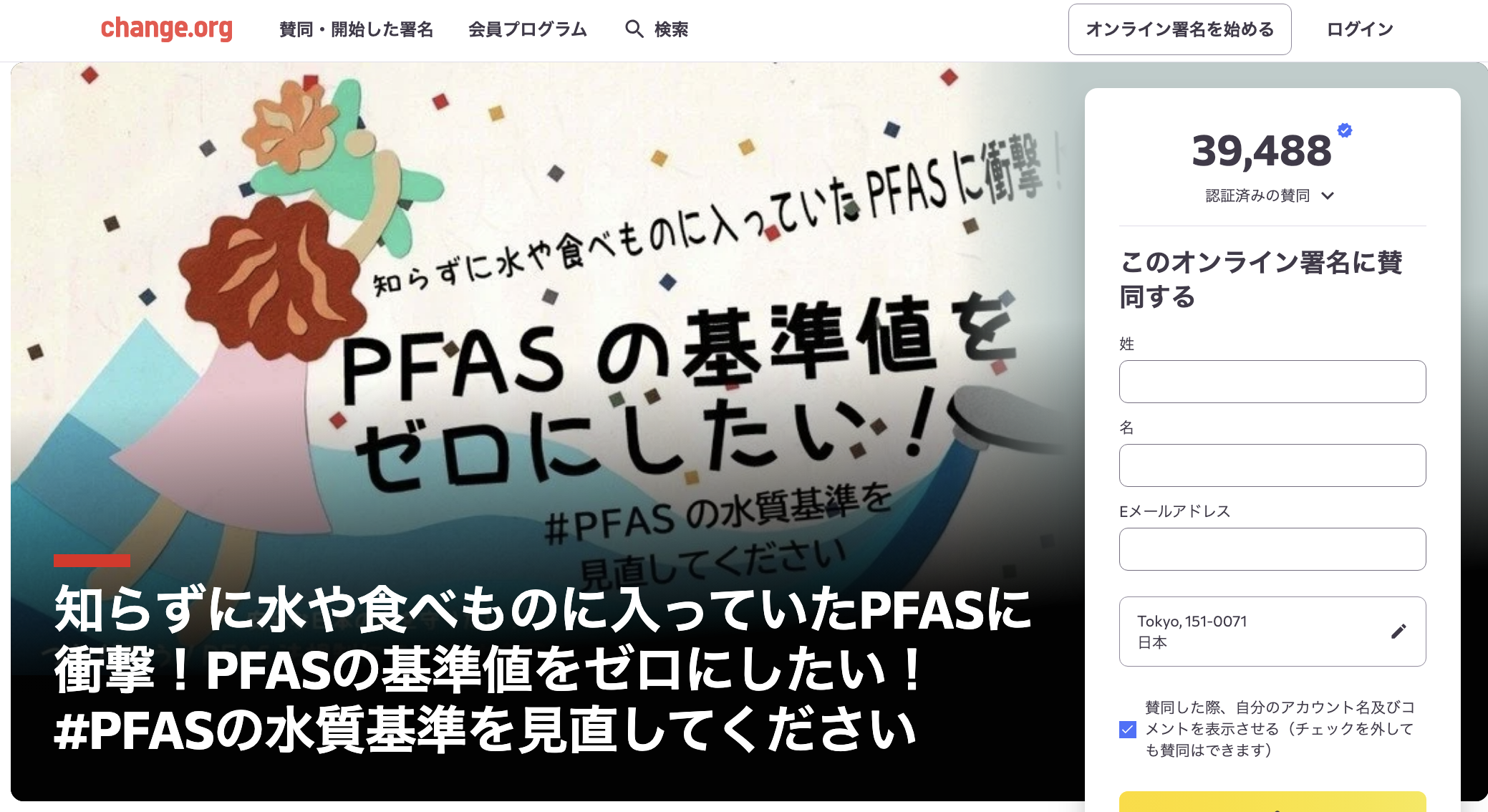
Online petition by “Let’s Connect! National Network Speaking Out for PFAS Regulation” (from the change.org website)
Eight women living in PFAS-contaminated areas across the country have launched the “Let’s Connect! National Network Speaking Out for PFAS Regulation.”
Effective April 1, 2026, tap water standards for PFAS will be established in Japan.
However, while the U.S. standard is 4 ng/L, Japan’s is a more lenient 50 ng/L. There are concerns about the impact on fetuses and children. The National Network (provisional name) has launched an online petition calling for “a review and the formulation of a roadmap to bring Japan’s PFAS water quality standards closer to international levels and, in the future, as close to zero as possible.”
They plan to submit the collected signatures to the Ministry of Health, Labour and Welfare, the Ministry of the Environment, the Ministry of Agriculture, Forestry and Fisheries, the Ministry of Land, Infrastructure, Transport and Tourism, and the Agency for Children and Families.
“First, align with U.S. standards”
The petition has been initiated by eight women living in Hokkaido, Tokyo, Shizuoka, Osaka, Hyogo, Okayama, and Okinawa. PFAS contamination caused by PFAS-related companies and military bases is occurring in all of these regions.
For example, levels of 30,000 ng/L (PFOA, 2024) were detected in groundwater in Settsu City, Osaka Prefecture; 1,400 ng/L (PFOA, 2023) in tap water in Kibi-Chuo Town, Okayama Prefecture; and 3,600 ng/L (PFOS, 2025) in wetlands in Okinawa City. These concentrations far exceed the provisional guideline value of 50 ng/L set by the government for health considerations.
Among the more than 10,000 types of PFAS, PFOA and PFOS are particularly toxic. Their dangers are recognized internationally. They have been found to cause various adverse health effects, including carcinogenicity, neurotoxicity affecting fetal and infant development, and pregnancy-induced hypertension.
Preeclampsia is a condition in which women who did not have high blood pressure before pregnancy develop hypertension between the 20th week of pregnancy and the 12th week postpartum; it is one of the primary diseases caused by PFOA. It can lead to maternal bleeding, impaired liver function, and fetal growth restriction, and in the worst cases, it can result in the death of both mother and child.
If PFAS in the environment are ingested through water or food, they can affect not only the individual but also fetuses and children. The women launched the group and began a petition drive to coincide with International Women’s Day on March 8, 2026.
Through this petition, they are demanding the government to address the following three points.
・Reduce the tap water standard of 50 ng/L to a level close to zero. To start with, align it with the U.S. standard of 4 ng/L or less.
・Conduct surveys and research on the health effects of PFAS, focusing on areas with high levels of PFAS contamination, particularly among pregnant women and new mothers, and provide compensation for any resulting health damage.
・Establish safety standards as soon as possible not only for tap water but for all water sources, soil, and agricultural and fishery products, and provide free public testing. Protect the safety of those engaged in agriculture and fisheries, and provide compensation for damages.
“Cannot be prevented by individual efforts alone”
One of the top priorities among these requests is to raise the standards to meet international levels.
On April 1, 2026, PFOA and PFOS will be added to the tap water standards. This decision was made in June 2025 under the Ishiba administration.
Until now, PFOA and PFOS were not included in tap water standards, and there was no requirement to measure their concentrations. Additionally, water utilities were left to decide how to react when amounts of 50 ng/L or higher—the provisional guideline value—were found.
Under these new standards, local governments and water utilities responsible for water supply administration are required to conduct regular measurements of PFOA and PFOS concentrations; if levels of 50 ng/L or higher are detected, they are required to report the findings and take corrective action.
However, the regulatory limit of 50 ng/L is insufficient for addressing PFAS.
For example, in the United States, the previous Biden administration developed a “PFAS Strategic Roadmap,” an effort to address PFAS contamination led by the government. A threshold of 4 ng/L was established as a standard designed to protect public health.
Moreover, the roadmap includes provisions for decontaminating contaminated areas and identifying polluters to hold them retroactively accountable.
Efforts to achieve zero detections are gaining momentum in Europe and other countries as well.
The National Network makes the following appeal.
Concerns are being raised across the country about whether a lenient standard of 50 ng/L, which applies only to tap water, is sufficient to protect the long-term health of pregnant women and children, and whether it reflects a safe level for water that people will continue to drink for decades.
Contamination from invisible chemicals cannot be prevented by individual efforts alone.
That is precisely why it is important to establish water quality standards based on scientific evidence to protect the health of future generations.
A plea from a mother whose 2-year-old son’s test results were 70 times the national average
One of the organizers, Kyoko Uehara (pseudonym) of Kibi-Chuo Town, Okayama Prefecture, states:
“When the tap water contamination was discovered two and a half years ago, we organized a petition drive in our town. This time, too, I decided to participate because I wanted to do something from a mother’s perspective.”
In October 2023, PFOA contamination was discovered in the tap water in Kibi-Chuo Town. Water containing 800 to 1,400 ng/L of PFOA, 16 to 28 times the standard limit, had been supplied as tap water for at least three years.
In November 2023, 27 residents, including Uehara, underwent blood tests conducted by a PFAS research team at Kyoto University. The results revealed high concentrations in all 27 individuals. The average concentration among the 27 was 171.2 ng/mL (median: 162.6 ng/mL), which is 77 times higher than the national average of 2.2 ng/mL published by the Ministry of the Environment.
Uehara herself had a high concentration of 97.7 ng/mL. However, her greatest concern was the health of her son, who was two years old at the time. A concentration of 151.9 ng/mL was detected in her son, more than Uehara’s own level. This is approximately 70 times the national average.
Uehara says: “My son, who was two years old at the time, was naturally thin, but over the past two and a half years, he has become severely obese, and we’ve even received guidance from a pediatrician. Childhood obesity is one of the health effects associated with PFAS. I don’t know if this is just a phase of growing up or the result of PFAS exposure, but the very fact that I have to worry about this is upsetting.”
“If the standard remains at 50 ng/L, regular exposure could potentially lead to illness. I believe we must acknowledge that PFAS are harmful to the body and align with other countries by setting stricter limits.”
Anyone who supports this campaign can sign the petition online.
Signature page: https://www.change.org/zero-pfas
(Originally published in Japanese on March 11, 2026. Translation by Mana Shibata.)
Polluted with PFOA: All articles