 Newsletter
signup
Newsletter
signup
Cabinet Decision to Hold a State Funeral “Was Considered by Only Four Bureaucrats to Maintain Confidentiality”; 56 Names Listed in the Approval Column of the Document Tansa Obtained
2026.01.16 17:37 Makoto Watanabe
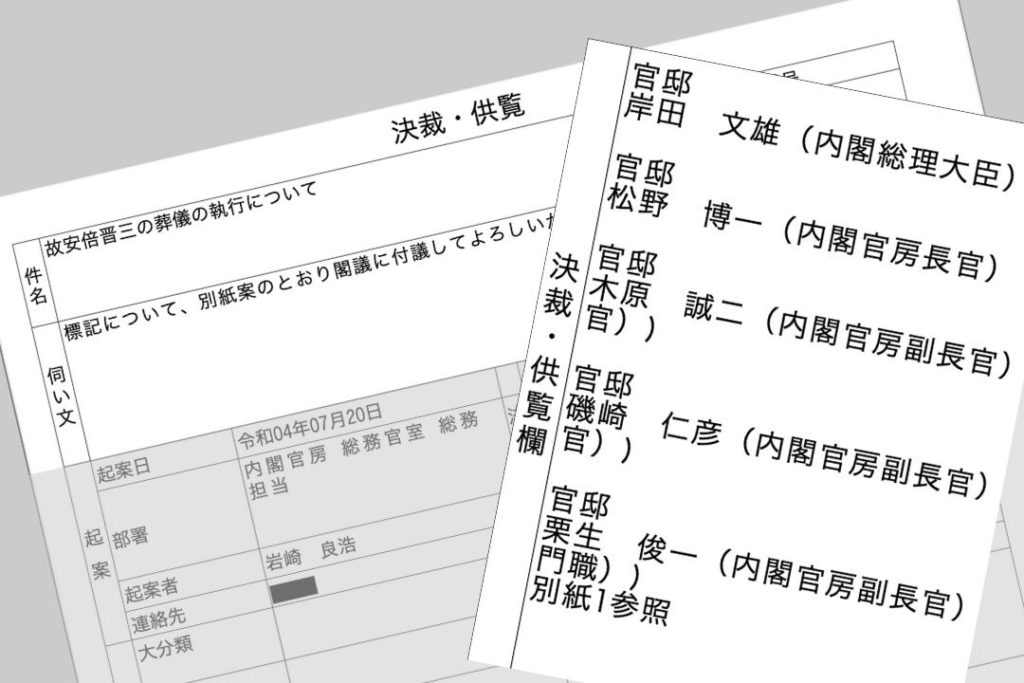
In a document obtained through a Freedom of Information request, the names of senior officials at the Prime Minister’s Office at the time are listed in the “Approval/Presentation” column (created by Tansa based on the document).
Should the Cabinet decide to hold a state funeral for former Prime Minister Shinzo Abe without consulting the Diet? The Prime Minister’s Office held discussions with the Cabinet Legislation Bureau over three days, from July 12 to 14, 2022.
Regarding the records of the three days of discussions, the government claims that no documents exist because they were either not created or discarded.
Tokyo District Court Presiding Judge Kenji Shinoda questioned the government during the fourth oral argument in October to “clarify what the deliberation and decision-making process for holding a state funeral were like.” By “decision-making process,” he meant the people responsible for the decision-making process.
Even if one didn’t participate in the three-day meeting, they still need to report to and consult with their superiors who are involved in the decision-making process, and the idea is that one should have recorded the contents of the meeting.
However, the government has given answers regarding the approval process that are contrary to the facts.
The fifth oral argument was held on December 23 from 1:30 pm in Courtroom 103 of the Tokyo District Court Grand Bench.
“From the perspective of confidentiality”
The homework that Presiding Judge Shinoda gave at the fourth oral argument was as follows:
What was the deliberation and approval process for the Cabinet Secretariat and Cabinet Office regarding the decision to hold a state funeral by cabinet decision?
In response, the government responded as follows:
Cabinet Secretariat:
“The decision to hold a state funeral, a national ceremony based on a cabinet decision, was considered by only two senior officials, former Counsellor Takayuki Nishizawa of the Cabinet Affairs Office, and his subordinate, former Counsellor Hiroshi Onmayashiki, from the perspective of confidentiality, given that the funeral was a formality for a former Prime Minister that is not a regular or routine part of Cabinet Office business. No other officials were involved in this matter.”
Cabinet Office:
“The decision to hold a state funeral, a national ceremony based on a cabinet decision, was considered by only two senior officials, former Director of the General Affairs Division of the Cabinet Office’s Minister’s Secretariat, Mamoru Nakajima, and former Deputy Director, Taro Tahara, from the perspective of confidentiality, given that the funeral was a formality for a former Prime Minister that is not a regular or routine part of Cabinet Office business. No other officials were involved in this matter.”
The decision to hold a state funeral by cabinet decision without consulting the Diet is a serious matter. Nevertheless, it is unbelievable that only four people, including counsellors and directors, have considered it.
The document obtained through a Freedom of Information request after Tansa filed suit against the government demonstrates that the government’s claims are factually incorrect.
The document obtained is titled “Regarding the Execution of the Funeral of the Late Shinzo Abe” from the Cabinet Secretariat and Cabinet Office. It was drafted on July 20, 2022, and states, “Regarding the subject matter, we would like to ask if it is okay to request a cabinet meeting,” with approval given on July 21. This is the deliberation process leading up to the cabinet decision to hold a state funeral.
The “Approval/Presentation” list contained the names of 56 people, including those who drafted the proposal and those who approved on behalf of others. It included the names of then Prime Minister Fumio Kishida, Chief Cabinet Secretary Hirokazu Matsuno, and other senior officials at the Prime Minister’s Office.
It also included the names of four people who the government said “exclusively considered the matter.”
(Originally published in Japanese on December 22, 2025. Translation by Mana Shibata.)
Democracy Behind Closed Doors: All articles